A guide to
Dietrich Buxtehude
Helsingør c. 1637 — Lübeck 1707

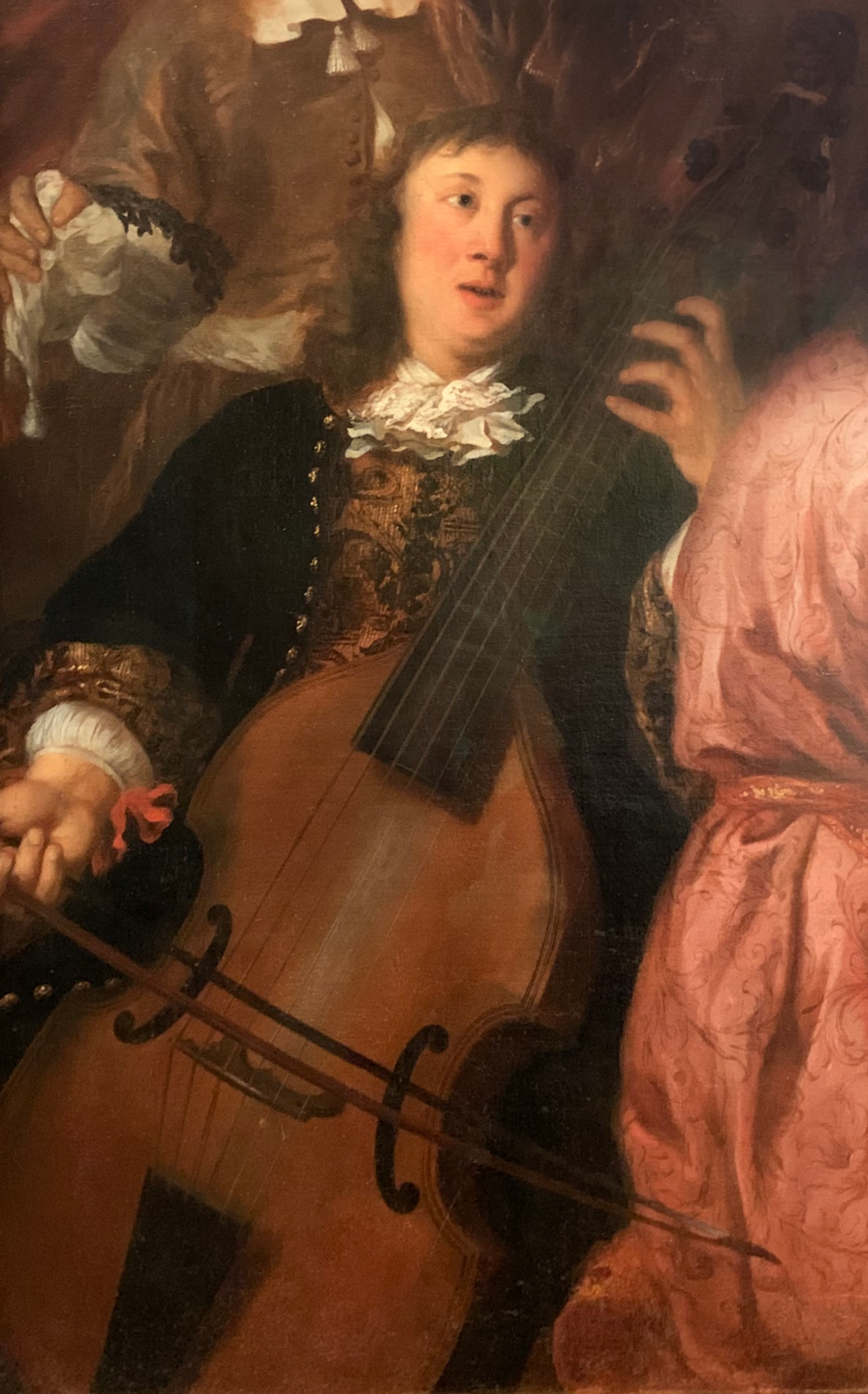
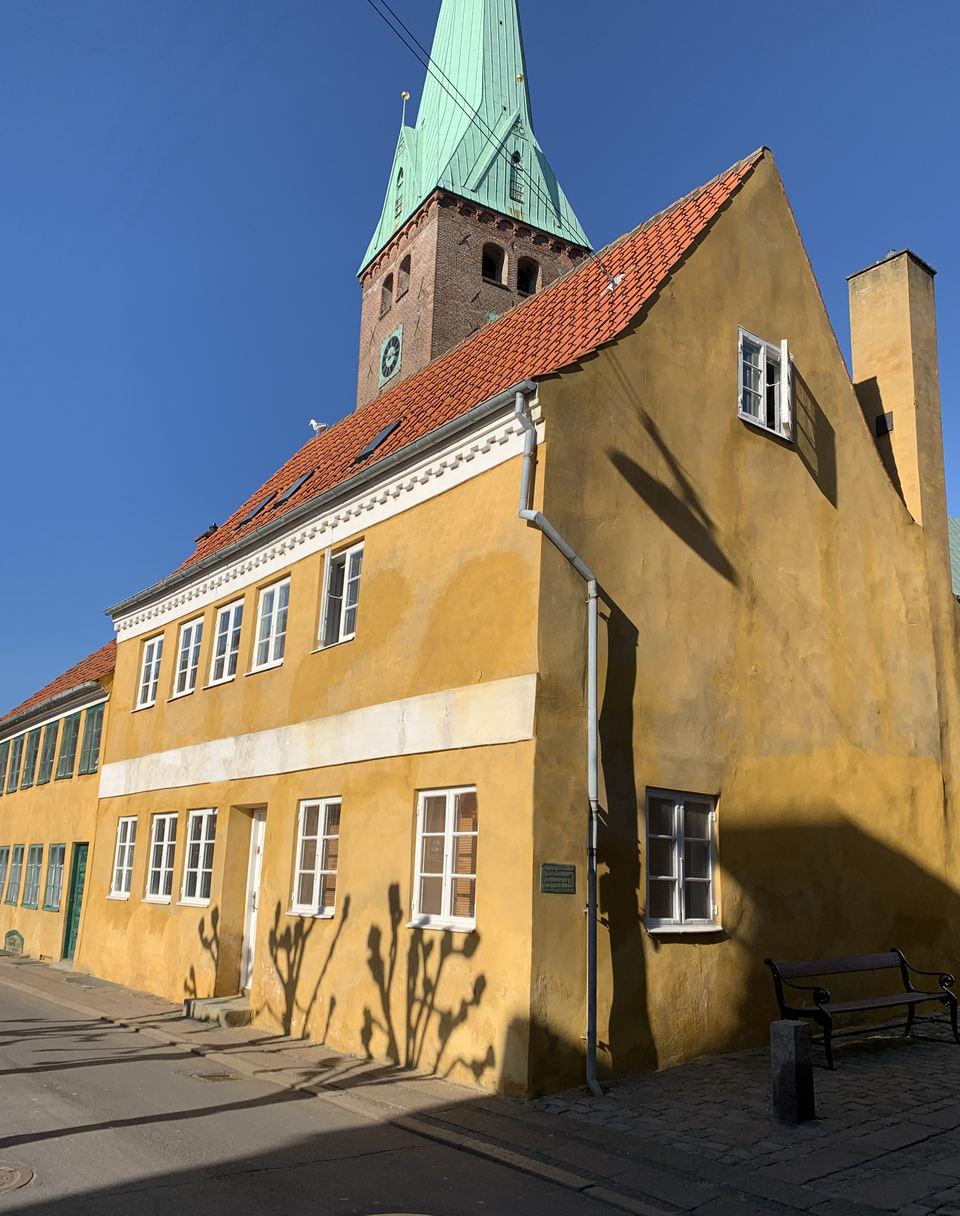
Dietrich Buxtehude was the leading organist of the North German school in the second half of the seventeenth century, and the only seventeenth-century German composer whose name still stands beside Bach’s in the ordinary concert hall. He was almost certainly born in Helsingør on the Sound, the narrow strait that separates Denmark from Sweden, where his father Johannes served as organist at Sankt Olai kirke. The family’s exact origins are still argued over — the surname is German, the birth records ambiguous — but Buxtehude spoke Danish, signed himself as a Dane on Marienkirche letters, and is buried in Lübeck under the German form of his name.
After early posts across the Sound in Helsingborg (1657–1660) and back home in Helsingør (1660–1668), he made the move that defined the rest of his life. In 1668 he succeeded Franz Tunder as organist of the Marienkirche in Lübeck, the post he would hold for thirty-nine years until his death.
The Marienkirche and the Abendmusiken
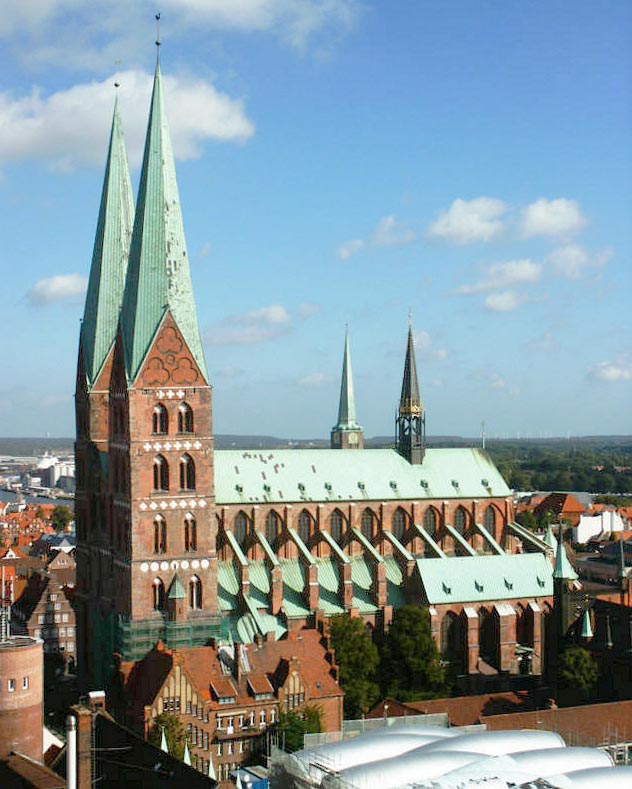
The Marienkirche post was musically grand and contractually peculiar. The appointment carried an unwritten obligation to marry Tunder’s daughter Anna Margaretha; Buxtehude did so in August 1668, three months after starting work. The same custom famously deterred two later visitors. In August 1703, George Frideric Handel and Johann Mattheson travelled together from Hamburg to Lübeck to audition as Buxtehude’s successor. They were politely received, played the organ, and left without applying — both, according to Mattheson’s own Ehrenpforte, having found the marriage clause “not very agreeable.”
Buxtehude’s distinctive contribution to Lübeck musical life was the Abendmusiken: large evening concerts of sacred dramatic music, mounted in the Marienkirche on the five Sundays preceding Christmas, paid for by the city’s merchants. Tunder had begun the tradition modestly with afternoon organ recitals; under Buxtehude it grew into multi-part oratorios performed by chorus and orchestra from purpose-built galleries inside the church, the financial accounting kept in a thick ledger that survives in the Lübeck archives.
Their fame travelled north and south. The young Johann Sebastian Bach, employed as organist at Arnstadt and barely twenty years old, took a four-week leave in autumn 1705 to “comprehend one thing and another about his art,” walked roughly four hundred kilometres to Lübeck, stayed nearly four months listening to the Abendmusiken, and was formally reprimanded on his return.
— after the 1754 Nekrolog by Carl Philipp Emanuel Bach and Johann Friedrich Agricola
Stylus phantasticus
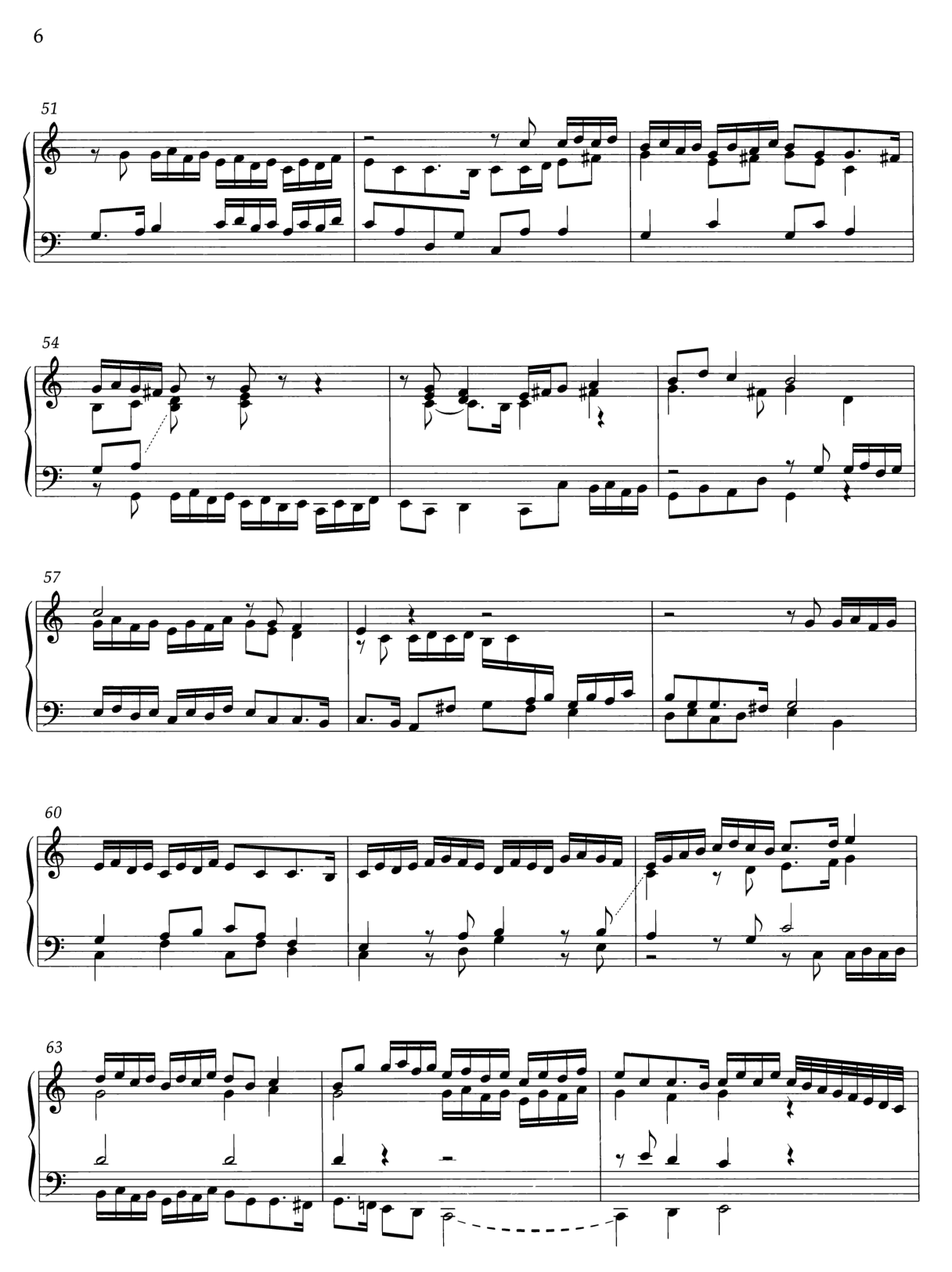
The free organ works — the seven great Praeludia (BuxWV 136–152), the two Chaconnes (BuxWV 159, 160), and the Passacaglia in D minor (BuxWV 161) — stand as the highest expression of the stylus phantasticus, a style characterised by rhapsodic sectional structure, abrupt changes of texture and figuration, bold chromatic harmony, and a deliberate sense of improvisation. A typical praeludium opens with a free pedaliter toccata, gives way to a strict fugue, returns through a transition to a second fugue (often in a contrasting metre), and closes with another toccata. The piece works as a rhetorical argument; each section is a fresh “speech” rather than a continuation of what came before.
The Praeludium in E major, BuxWV 141, is itself a virtuoso statement of intent: E major was practically out of reach on the meantone-tuned organs of the North German tradition, where the key produced excruciating wolf intervals. Buxtehude’s choice presupposed a well-tempered instrument — or a player willing to brave the dissonances. On a modern equal-tempered organ the brilliance survives without apology.
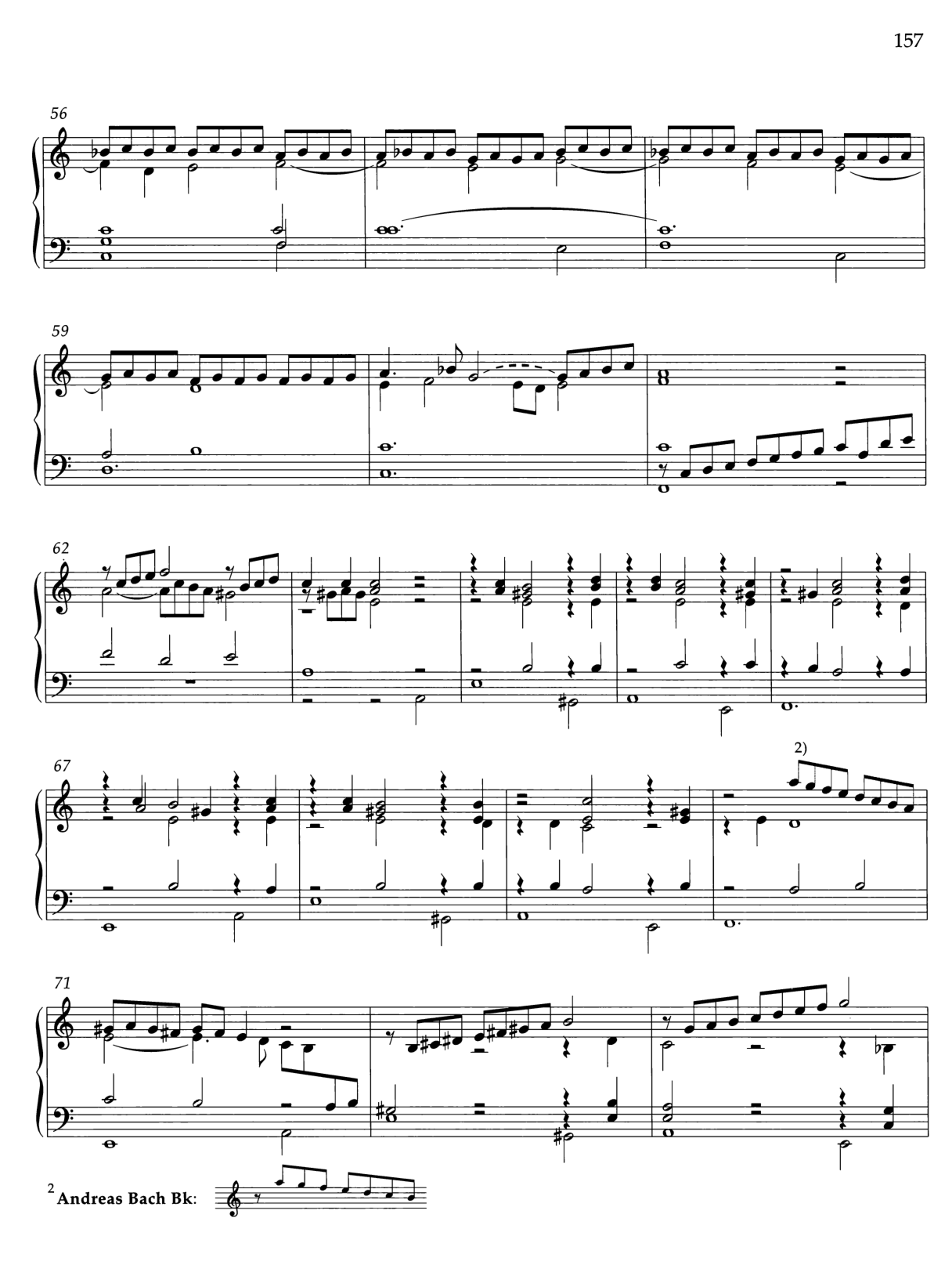
The Passacaglia in D minor is among the most architecturally ambitious organ works of the seventeenth century, and the single piece by which Buxtehude is most often introduced today. Twenty-eight statements of a four-bar ground bass are grouped into four sections of seven, each shift of key separated by a short modulating interlude. The symmetry is deliberate and audible. It is the direct ancestor of Bach’s own Passacaglia in C minor, BWV 582 — which Bach almost certainly knew through the same Lübeck manuscripts he had spent four months copying out.
The chorale repertory

Alongside the free works sit nearly fifty chorale-based organ works: chorale preludes, chorale fantasias, and chorale variations on the central tunes of the German Lutheran year. They make distinctive use of the divided North German organ — the chorale melody projected by a solo reed or Sesquialtera on one manual, the accompaniment on a contrasting Werk, the pedal carrying the cantus firmus or the bass line as required.
Within the chorale settings, two strands recur. The smaller pieces — the short, two-page chorale preludes that fill most of the BuxWV 177–224 range — introduce the congregation to the tune of the day before the singing begins; many are manualiter (without pedals) and could be played on harpsichord as domestic devotion. The larger pieces, the great chorale fantasias (BuxWV 210, BuxWV 223 Wie schön leuchtet der Morgenstern), build the chorale into an extended sectional drama, each phrase of the tune becoming a new movement in its own right.
Vocal music and the Düben Collection
Buxtehude wrote far more vocal music than survives in modern recital programs. Most of it reaches us not through Lübeck sources, which were largely destroyed when the Marienkirche was bombed in 1942, but through the Düben Collection in Uppsala: a working library assembled by the Düben family of Stockholm court musicians, who corresponded with Buxtehude and kept performance copies of his sacred concertos, chorale concertos, cantatas, and one full-scale oratorio. Without Uppsala, perhaps three-quarters of the vocal output would be lost.
The single most extraordinary cycle is Membra Jesu Nostri (BuxWV 75, 1680), a sequence of seven short cantatas — one for each crucified limb of Christ, ascending from feet to face — set to medieval Latin meditative verse. The cycle is often described as the first true Lutheran oratorio: dense, intimate, intensely focused, and arguably Buxtehude’s most personal achievement. It anticipates Bach’s St. John Passion by forty-four years.
What Bach took
Bach’s debt to Buxtehude is not a matter of one piece resembling another; it is a vocabulary. The pedaliter virtuosity, the rhetorical use of abrupt contrast, the dramatic deployment of the full plenum, the architecture of the prelude-fugue chain — all of it is in Buxtehude first, and Bach’s mature output is unimaginable without him. The Passacaglia BWV 582 owes the Passacaglia BuxWV 161 not just its form but its bearing. The great Toccata in D minor BWV 565, whatever its authorship, speaks in a North German accent. Even the chorale fantasias of Bach’s Weimar years carry forward the contrapuntal logic of pieces like Nun freut euch, lieben Christen g’mein BuxWV 210 — a work Bach demonstrably knew, since he later copied portions of it into his Möller manuscript.
Buxtehude died on 9 May 1707, four months before his successor — finally neither Handel nor Bach but Buxtehude’s own assistant Johann Christian Schieferdecker, who duly married Anna Margreta — took up the Marienkirche post. Bach was by then in Mühlhausen, two years away from Weimar and the beginning of his great organ years. What Buxtehude had given him would last the rest of his life.