A guide to
George Frideric Handel
Halle 1685 — London 1759
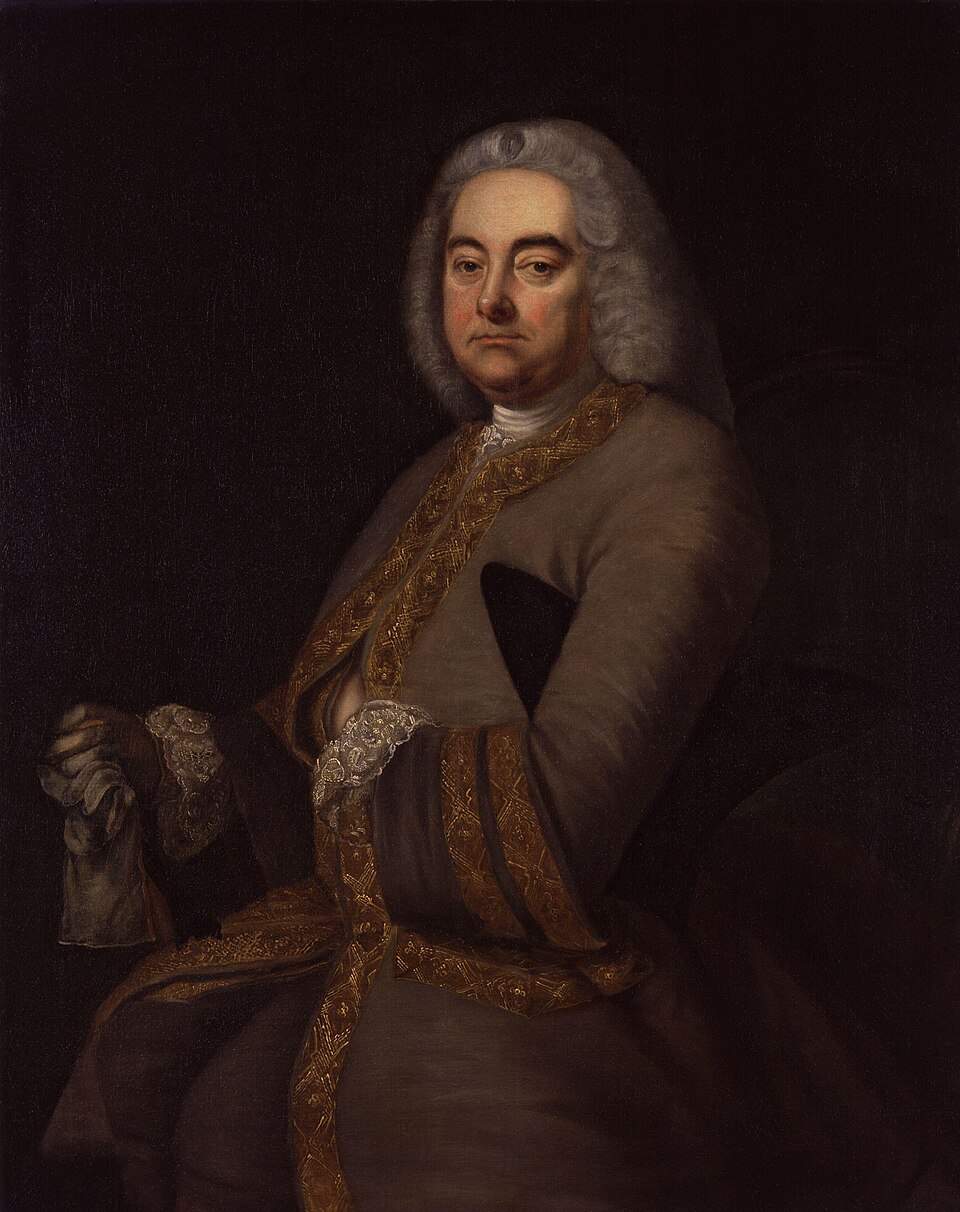
George Frideric Handel was born Georg Friedrich Händel in Halle on 23 February 1685 — five weeks before Johann Sebastian Bach was born in Eisenach, in a town one day’s ride to the south. His father was a sixty-three-year-old surgeon-barber to the court of Saxe-Weissenfels who had explicitly forbidden the boy from any musical study, and who supposedly had any keyboard instrument removed from the house. By family tradition, recorded by Handel’s first biographer John Mainwaring in 1760, the young Handel smuggled a clavichord into the attic and practised on it secretly at night.
He found means to get a little clavichord privately convey’d to a room at the top of the house. To this room he constantly stole when the family was asleep. He had made some progress before Musick had been prohibited; and by his assiduous practice at the hours of rest, he had made much greater.
— John Mainwaring, Memoirs of the Life of the Late George Frederic Handel, London 1760
The discovery came indirectly. On a visit with his father to the Saxe-Weissenfels court — Handel was perhaps nine — the boy slipped into the empty palace chapel after service and began to improvise on the organ. The Duke heard him from his apartments, came down, and reportedly told Handel’s father in tones admitting no debate that the boy must be allowed to study music. He was allowed.
Hamburg, the duel, the Italian years
In 1703, age eighteen, Handel left Halle for Hamburg — Germany’s most cosmopolitan musical city — and took a job as a back-desk violinist at the Oper am Gänsemarkt under Reinhard Keiser. He shared lodgings with the composer-critic Johann Mattheson, four years older, who would later write the indispensable biographical sketch in his 1740 Grundlage einer Ehren-Pforte.
The friendship ended in a duel. On 5 December 1704 the two were directing the orchestra of Mattheson’s opera Cleopatra; Mattheson was singing the role of Antonius and, when his character died on stage, he came down to the harpsichord to direct the rest of the act — only to find that Handel, who had been directing from the keyboard during Mattheson’s singing, refused to give up the bench. The two left the theatre at the end of the performance and drew swords in the Gänsemarkt square. Mattheson lunged. According to his own account, his sword struck Handel’s coat button and the button broke the blade. Both men survived. They reconciled within weeks. Mattheson never quite forgot.
In late 1706 Handel left Hamburg for Italy, the journey that defined his style for life. He spent the next four years in Florence (Prince Ferdinando de’ Medici), Rome (Cardinals Ottoboni, Pamphili, and Colonna), Naples (the Spanish viceroy), and Venice (the Gritti and Grimani families). In Rome the popes had banned opera as morally suspect, so Handel composed oratorios instead — La Resurrezione in 1708 with Corelli leading the violins, and Il Trionfo del Tempo e del Disinganno, his first complete dramatic work. In Naples he wrote the Aci, Galatea e Polifemo of 1708. In Venice, Christmas 1709, the opera Agrippina ran for twenty-seven consecutive nights to standing ovations.
It was in Rome that Cardinal Pietro Ottoboni organised the famous keyboard contest with Domenico Scarlatti. The two young virtuosos were exactly the same age — both twenty-three. The verdict, as recorded by Mainwaring: Scarlatti won the harpsichord, Handel won the organ. Scarlatti was so impressed by Handel’s organ playing that he is said to have crossed himself whenever Handel’s name was mentioned for the rest of his life. The two never met again.
London and the operas
In 1710 Handel was offered the Kapellmeister post at Hanover under Elector Georg Ludwig — the same Georg Ludwig who, four years later, would become King George I of Great Britain under the Act of Settlement. Handel accepted the Hanover post, then within months left for London on what was supposed to be a brief visit. The opera Rinaldo premiered at the Queen’s Theatre, Haymarket on 24 February 1711 to a sensation; Handel was offered (and accepted) money to stay. He returned to Hanover after a year, then in 1712 left again, this time permanently, for England.
When his old employer became King in 1714, the relationship had to be managed carefully — there is a long-standing (and false) story that the Water Music of 1717 was composed as a gesture of reconciliation between an offended monarch and his recalcitrant former Kapellmeister. The truth is more prosaic: the Water Music was commissioned for a royal procession down the Thames in the king’s barge, with fifty musicians on a separate barge alongside, and was paid for by the king. The legend of estrangement and reconciliation persists because it ought to be true.
From 1719 to 1737 Handel ran the Royal Academy of Music as London’s primary opera company, premiering thirty-five Italian operas. The competing Opera of the Nobility ate his audiences in the late 1720s and early 1730s; he was bankrupt by 1737. Out of the bankruptcy came the second act of his career: English-language oratorio, performed in concert form during Lent (when opera was forbidden), without the staging that opera required, and aimed at the burgeoning English middle class. The first oratorio was Esther (1718, revised 1732). The masterwork was Messiah.
Messiah
Messiah was composed in London between 22 August and 14 September 1741 — twenty-four days. The autograph score survives in the British Library and shows that Handel composed essentially without revision; the famous “He shall feed his flock” was the only major movement reworked between draft and performance. The libretto was a compilation of biblical texts assembled by Charles Jennens, an English country gentleman, theologian, and amateur Bach enthusiast.
The work premiered not in London but in Dublin on 13 April 1742, at the new Music Hall in Fishamble Street, as a benefit performance for three Irish charities — the proceeds went jointly to the Charitable Musical Society, the Mercer’s Hospital, and the prisoners of the city’s debtors’ jail. Several debtors were freed on the strength of the takings.
The famous tradition of standing during the Hallelujah chorus has no documented origin in Handel’s lifetime. The earliest record dates from 1750, at a London performance attended by King George II, who stood up — accounts vary as to whether from emotion, from a leg cramp, from etiquette (perhaps he thought he was being summoned, as the chorus opens “Hallelujah! For the Lord God omnipotent reigneth”), or from simple confusion. When the king stands, the audience stands; the tradition stuck.
Blindness, Taylor, and the Abbey
Handel’s vision began to fail in early 1751 — by his own report he was working on the oratorio Jephtha when he first noticed difficulty with his left eye. He sought out John Taylor, the same itinerant oculist who would later operate on Bach. Taylor performed cataract “couching” — pushing the clouded lens out of the line of sight with a needle, without anaesthetic — on Handel three times between 1752 and 1758, with no lasting success. Handel was completely blind by 1753 and remained so for the last six years of his life. He continued to direct Messiah and the other oratorios from memory, with an assistant turning pages of music he could no longer see.
He died at his house in 25 Brook Street, London, on 14 April 1759, age seventy-four. The funeral, on April 20, drew an estimated three thousand mourners to Westminster Abbey, where Handel was buried in Poets’ Corner beneath a marble monument by Roubiliac that shows him holding the manuscript of Messiah opened at the aria “I know that my redeemer liveth.” He is the only foreign-born composer interred in the Abbey.
The will left £1,000 to the Foundling Hospital in Bloomsbury — the orphanage Handel had supported with annual benefit performances of Messiah since 1750 — together with the autograph score and parts of Messiah itself. The Hospital still preserves them. The annual Messiah benefit continued for fifty years after his death and is the reason most of Handel’s surviving performance materials are intact.
The estate left £600 to be spent on a monument in Westminster Abbey. He had specified the design himself.