A guide to
Louis Vierne
Poitiers 1870 — Paris 1937
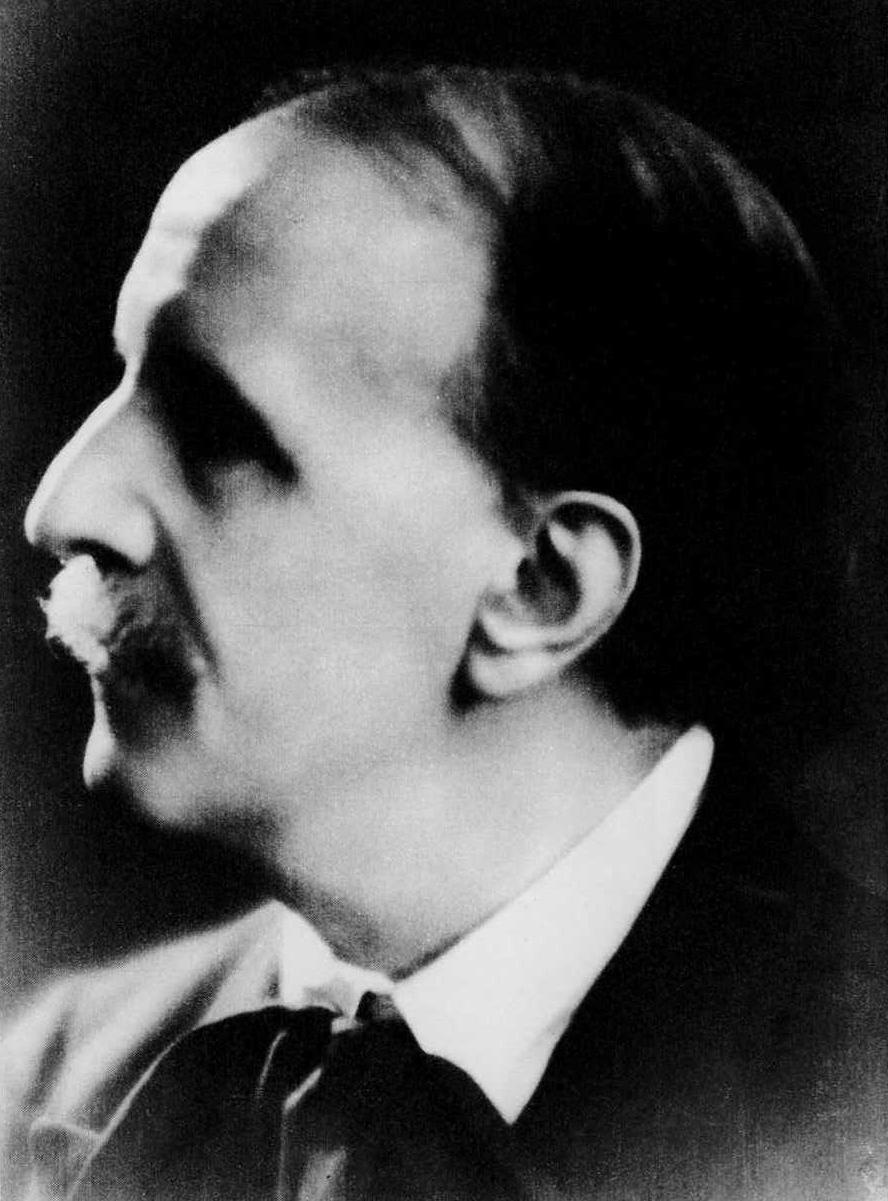
Louis Vierne was the blind master of the great organ of Notre-Dame de Paris and the composer who carried the French symphonic-organ tradition to its Romantic summit. Born with his eyes clouded by cataract, he saw almost nothing for the whole of his life and read music, when he could read it at all, with the page all but pressed to his face; yet from the loft of the most famous cathedral in France he poured out six organ symphonies, four suites of Pièces de fantaisie, and a vast body of sacred and chamber music, and he trained a generation of organists who carried his art across Europe and America. He stood in a direct apostolic line — pupil first of César Franck and then of Charles-Marie Widor, the two men who between them invented the organ symphony — and he closed that line in the grandest way imaginable: he died at his console, in the middle of a recital, with his foot resting on a low pedal note that went on sounding into the dark cathedral.
He was born on 8 October 1870 at Poitiers, nearly blind from congenital cataracts. His gift announced itself long before anyone knew what to do about his eyes: at the age of two, by the family account, he picked out a Schubert lullaby on the piano after a single hearing. An iridectomy on both eyes when he was six gave him just enough sight to tell shapes apart and to read large letters held close to his face — never more than that. In 1881 the ten-year-old was sent to the Institution Nationale des Jeunes Aveugles in Paris — the National Institute for Blind Youth, the same school that had produced Louis Braille — and there his life found its direction.
A blind child among the organs
At the Institute he studied harmony with César Franck — by then near the end of his life, organist of Sainte-Clotilde and the most revered teacher in Paris — and organ with Louis Lebel and Adolphe Marty. The decisive moment was simply hearing Franck play. Vierne never forgot the shock of it:
The organ played a mysterious prelude … I was bowled over and became almost ecstatic.
— Louis Vierne, recalling his first hearing of César Franck at the organ, 1881
When Franck died in 1890 — the same year Vierne entered the Paris Conservatoire as a full-time student — the organ class passed to Franck’s successor, Charles-Marie Widor. Under Widor, Vierne took the Conservatoire’s first prize in organ in 1894, and Widor thought so highly of him that he made him his assistant, both in the organ class and at Saint-Sulpice, where Widor presided over the largest Cavaillé-Coll organ in Paris. From 1896 Vierne also assisted Alexandre Guilmant. He had, in other words, served at the feet of all three of the men — Franck, Widor, Guilmant — who between them founded the modern French organ school.
Notre-Dame
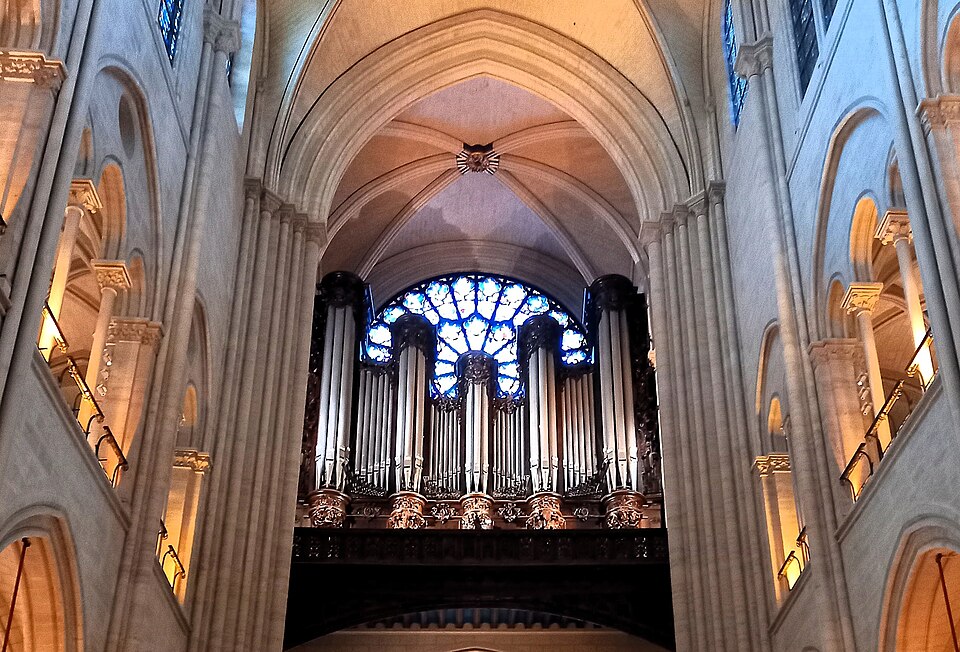
On 21 May 1900 the post that would define his life fell vacant, and Vierne — barely thirty, and still only an assistant — won it in open competition: titular organist of Notre-Dame de Paris. The instrument was one of Aristide Cavaillé-Coll’s masterpieces, the great symphonic organ he had rebuilt for the cathedral in the 1860s, with its five manuals and its orchestra of stops. Vierne would hold the loft for thirty-seven years, through war, blindness, exile and private catastrophe, until the day he died at its keys.
He was not an easy colleague — proud, exacting, and forever embattled with the cathedral chapter over the neglected, wheezing condition of his beloved organ — but at the console he was supreme. Like Franck before him, his improvisations were spoken of as the equal of his written music; and like Franck, he composed not for the liturgy but for the concert, treating the Cavaillé-Coll instrument as a one-man orchestra.
The organ symphonist
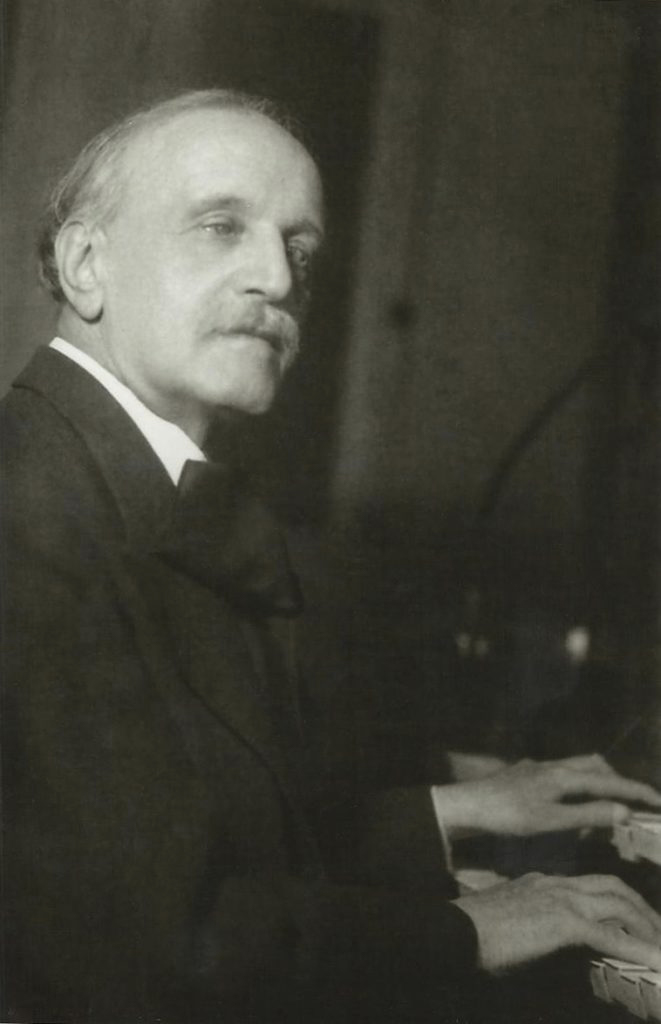
Vierne’s central achievement is the cycle of six organ symphonies, written across almost the whole span of his career — from the First, in D minor, Op. 14 (1898–99), composed on the eve of his Notre-Dame appointment, to the Sixth, in B minor, Op. 59 (1930). They are “symphonies” in Widor’s sense: large, secular, multi-movement works built for the orchestral colours of the Cavaillé-Coll organ. But where Widor is sunlit and Franck mystical, Vierne’s harmonic world is darker, more chromatic, more anxious — a sound entirely his own. The First Symphony closes with a Final — a toccata with the theme striding through the pedals under a glitter of manual figuration — that became one of the most played of all French organ movements.
The summit of the cycle is usually reckoned the Third Symphony, in F-sharp minor, Op. 28, composed in 1911 (he began it on 18 March and finished it on 14 September) and dedicated to his most brilliant young pupil, Marcel Dupré, who gave the première at the Salle Gaveau in 1912. Tautly built in five movements, it ends with a Final that lays the rushing ostinato of the French toccata over a slow bass melody and drives it, through genuine counterpoint and a thundering augmented pedal line, to a blazing close.
Years of catastrophe
No composer of his rank lived a life more crowded with disaster. In 1906 a fall in a Paris street broke his leg so badly that amputation was feared; he kept the leg, but spent six months painfully relearning the pedal technique on which an organist’s whole art depends. In 1909 his marriage ended in divorce. Worst of all came the years of the First World War. In 1916 Vierne travelled to Lausanne, in Switzerland, for a series of operations on his ruined eyes — glaucoma now compounding the old cataracts — expecting to be gone four months; complications kept him stranded there, far from his organ, for four years, until 1920. While he was in exile the war took his family: his son Jacques died in 1917, and his brother René was killed in action in 1918. Vierne poured his grief into his Piano Quintet, Op. 42, written in memory of his son. That he came home at all, and rebuilt his playing and his composing around the little sight that remained, is among the quiet heroisms of music history.
The Pièces de fantaisie and the New World
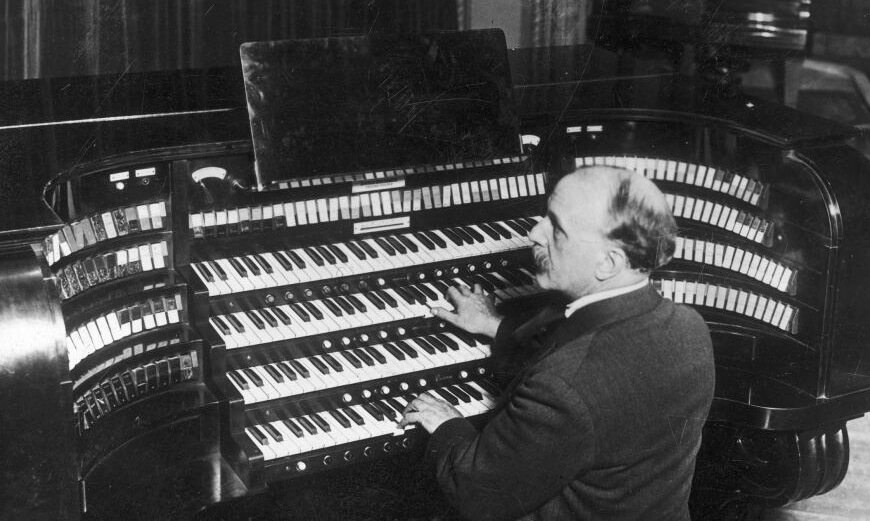
Recognition, when it came in full, came in an unexpected place: America. In 1927 Vierne, by then a figure of legend, made a celebrated North American tour, playing the giant concert organs of the New World — among them the colossal instrument of the Wanamaker store in New York, where his First Suite of Pièces de fantaisie was first heard on 4 February 1927. Out of these years came the four suites of Pièces de fantaisie, Opp. 51, 53, 54 and 55 (1926–27), a treasury of character-pieces, many of them dedicated to the American and English builders who had befriended him.
Two of them are the best-loved music he ever wrote. Clair de lune (Suite No. 2, dedicated to the Boston organ-builder Ernest M. Skinner) is a hushed nocturne in D-flat that floats over the softest stops of the instrument. And the Carillon de Westminster (Suite No. 3, dedicated to the London builder Henry Willis III) takes the Westminster Quarters — the chiming tune of Big Ben — and spins a whole movement from it, the bells climbing from a single distant phrase to a full-organ peal that has rung out from a thousand recital encores since. Vierne first played it at Notre-Dame on 29 November 1927.
The console
On the evening of 2 June 1937, Louis Vierne climbed once more to the loft of Notre-Dame to give what had been announced as his 1,750th organ recital. He played his programme, which included the Stèle pour un enfant défunt from his Triptyque, Op. 58; then, as he began to improvise on a submitted theme, he collapsed at the keyboard. As he slumped, his foot came down on the low E of the pedalboard, and the single deep note went on sounding through the cathedral. He was dead. His pupil Maurice Duruflé, who was at his side in the loft that night, was among the last to see him alive.
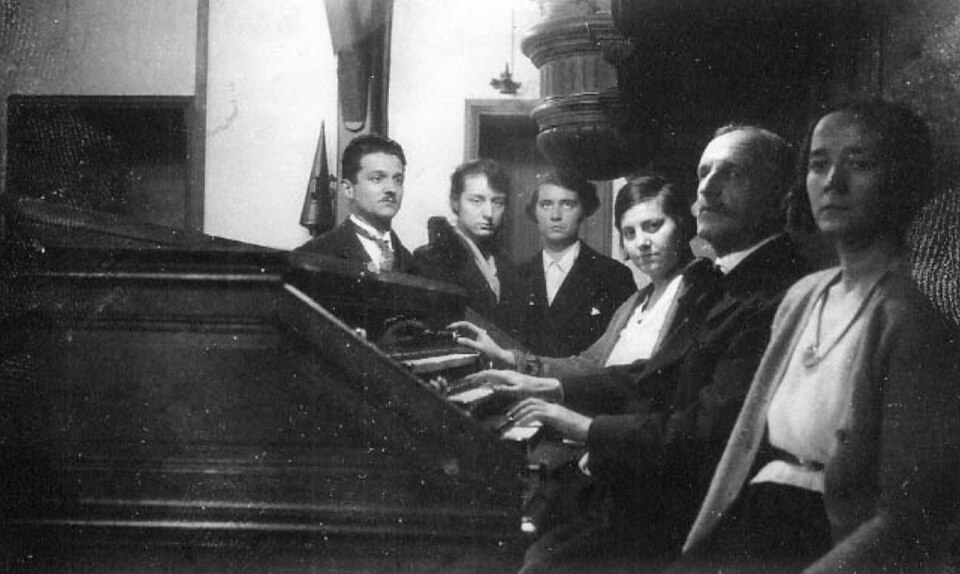
His pupils carried his art everywhere. Through the Conservatoire (where he taught for nineteen years), the Schola Cantorum (from 1912) and his own classes there passed Marcel Dupré, Maurice Duruflé, Joseph Bonnet, Augustin Barié, Henri Mulet, and the sisters Nadia and Lili Boulanger — Nadia Boulanger going on to become perhaps the most influential teacher of composition of the twentieth century. The line Vierne had received from Franck and Widor he handed on intact: the conviction, shared across the Rhine by Reger and rooted ultimately in Bach, that the organ could speak with the voice of a whole orchestra, and that the symphony, the toccata and the character-piece were as native to its loft as to the concert hall. His six symphonies and the Pièces de fantaisie remain at the centre of the organist’s repertoire, and the Carillon de Westminster is among the most-played of all French organ pieces — the cathedral bells of a man who spent his life in the dark, ringing out into the light.