A guide to
Girolamo Frescobaldi
Ferrara 1583 — Rome 1643
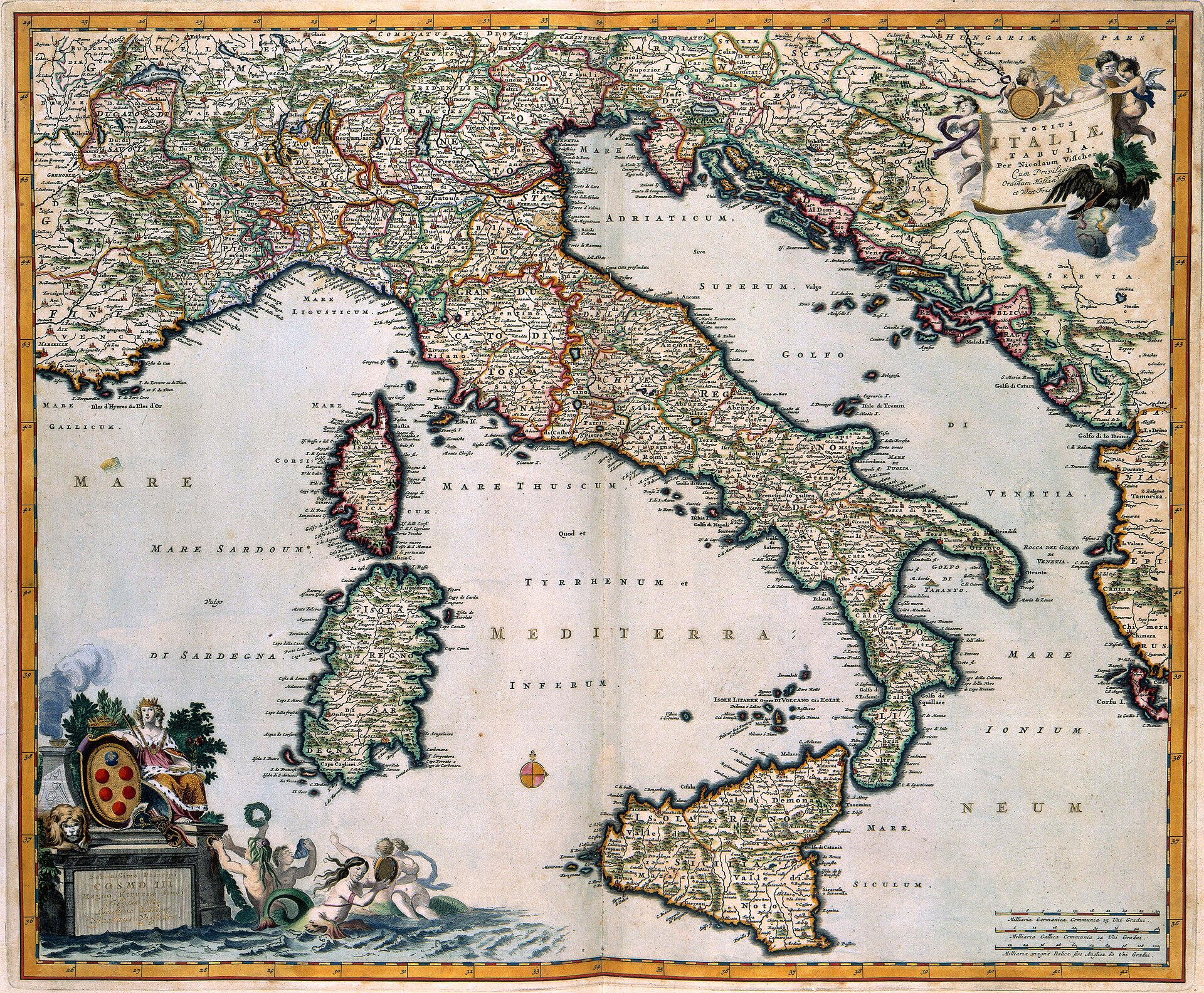
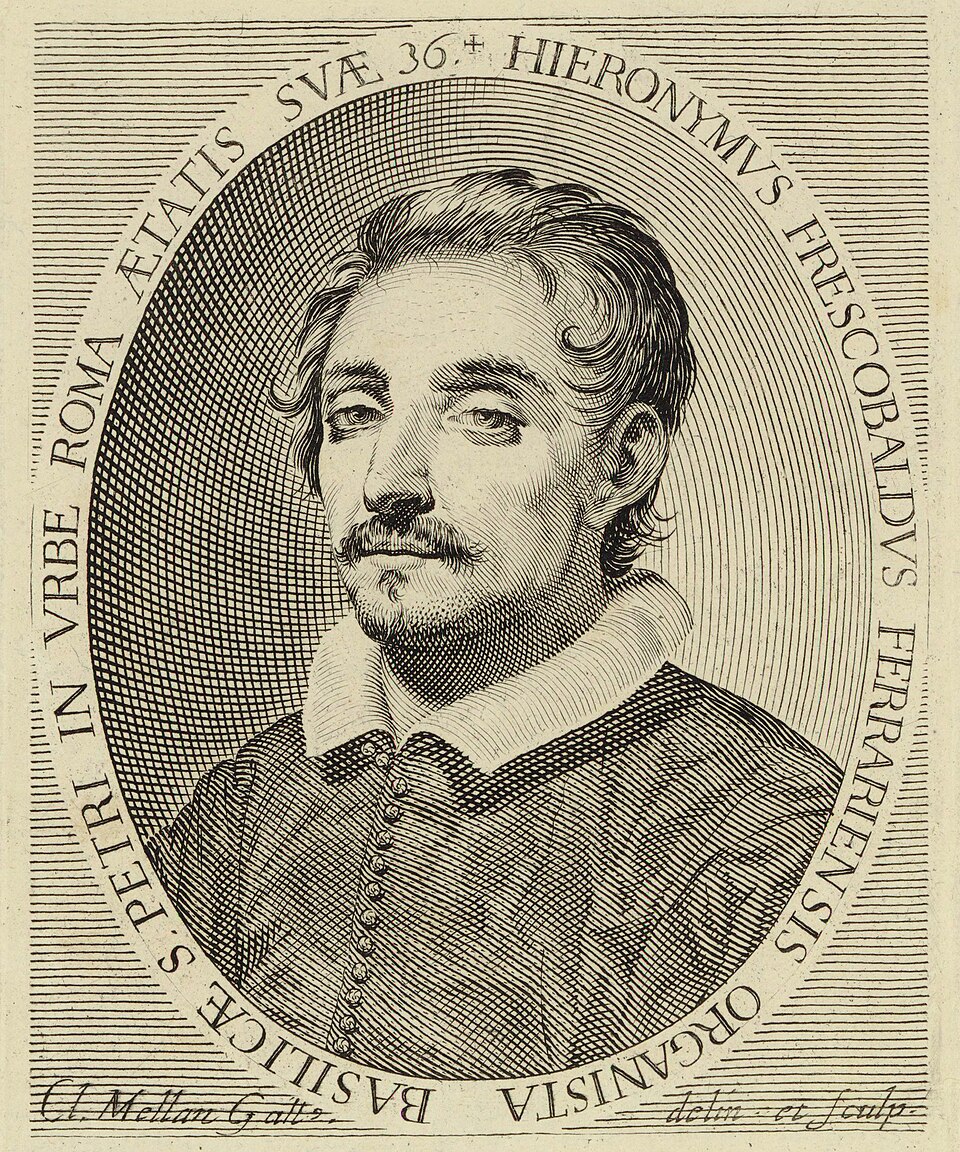
Girolamo Frescobaldi was born in Ferrara in September 1583, at the precise historical moment when the seconda prattica — the new style of monodic, expressive, harmonically adventurous music — was being invented in the city he grew up in. Ferrara under Duke Alfonso II d’Este was the laboratory of late Renaissance Italy: home to the concerto delle donne (the singing-women whose virtuosity inspired the early Baroque solo idiom), to Carlo Gesualdo (visiting in 1594 to marry Leonora d’Este), and to Luzzasco Luzzaschi, the duke’s chamber organist and the boy Frescobaldi’s teacher. Luzzaschi was a personal friend of Gesualdo and a regular accompanist to the concerto delle donne; he taught his pupil the keyboard idiom of Ferrara’s court — chromatically wild, rhythmically flexible, and oriented toward the rhetorical affetti the duke’s circle prized above all else. When the duke died in 1597 and the Este court collapsed under papal pressure, the fourteen-year-old Frescobaldi lost his patrons but kept the style.
He emerges next in Rome around 1604, attached as a young virtuoso to the Roman Academy of St. Cecilia. In 1607 he travelled to Flanders — Antwerp, Brussels, perhaps as far as the Netherlands — in the entourage of Guido Bentivoglio, the papal nuncio. There he printed, in Antwerp in 1608, his first publication: Il primo libro de’ madrigali a cinque voci, dedicated to Bentivoglio.
The same year, back in Rome, he was appointed organist of St Peter’s Basilica in succession to Ercole Pasquini. He was twenty-five.
The crowd of thirty thousand

The contemporary Roman composer Antimo Liberati, writing decades later in a letter of 1685 to compare the music of his age unfavourably with that of his teachers, gave Frescobaldi’s St Peter’s appointment a single sentence that has marked him ever since:
When he first played at St Peter’s, more than thirty thousand persons thronged to hear him.
— Antimo Liberati, letter to Ovidio Persapegi, 15 October 1685
Liberati’s number is almost certainly an exaggeration — St Peter’s nave, even packed, holds at most fifteen thousand standing — but the underlying fact is clear from the financial records: Frescobaldi’s organ playing at St Peter’s drew the kind of public audience the Roman cardinals had previously associated only with castrato singing and political processions. He was, in his own city and lifetime, more famous as a keyboard player than as a composer.
The published toccatas: a treatise without a text
In 1615 Frescobaldi published in Rome his Toccate e partite d’intavolatura di cembalo, Libro Primo — twelve toccatas, a set of canzonas, partitas on standard basses (the Romanesca, the Monicha, the Folia), all engraved on the new copperplate process that allowed unprecedented accuracy of beaming and ornamentation. The preface he attached is one of the founding documents of Baroque performance practice. It instructs the player as follows:
First: this manner of playing must not be subject to strict time — non si deve far stretta tatta — as we see practised in modern madrigals, which though difficult are made easy by means of the time, now dragging it, now hastening it, even letting it disappear in the air, according to the affetti or the meaning of the words. Second: in the Toccatas, take notice that the parts may be played either together or separately, beginning each as one wishes, without any obligation to begin from the beginning. Third: the beginnings of the Toccatas must be played slowly and arpeggiati — let the chords be broken — for otherwise the instrument seems dry. Fourth: in those passages of trilli and passaggi, even though they be written in equal notes, it is well to sustain the trill con un poco di stesa — a little stretched out.
— Frescobaldi, preface to the Toccate e partite, Libro Primo, Rome 1615
That preface — the licence to rubato, the licence to play sections separately, the licence to break chords for resonance — became the unspoken rulebook for every keyboard player who studied his music. It is the first explicit statement of what we now call flexible Baroque tempo.
The toccatas themselves are unlike anything written before. They are short — three or four minutes each — sectional, full of abrupt textural and harmonic shifts, threaded with the durezze (deliberate dissonant suspensions) and ligature (chains of cross-relations) that Luzzaschi had taught him. Toccata IX of the second book (1627) ends with the famous engraved instruction “non senza fatiga si giunge al fine” — not without effort is the end reached — a confession that the player will struggle, and a promise that the effort is worth it.
Florence, the plague, the Fiori musicali
In 1628 he was lured away from Rome by an offer from Ferdinand II de’ Medici to become court chamber-music director in Florence. He stayed for six years — partly, it now seems clear, to escape the plague that was tearing through Rome and central Italy in those years. The Medici archives record his salary as one hundred and eighty Florentine scudi per annum, with apartments in the Palazzo Pitti.
The Florence years produced two further publications, then, in 1634, he was back in Rome and back on the St Peter’s bench. In 1635 he published the work that would seal his reputation across Europe: Fiori musicali (“Musical Flowers”), three complete organ Masses — the Messa della Domenica, the Messa delli Apostoli, and the Messa della Madonna — each providing every piece of music a Roman organist needs to play between the parts of the Mass: a Toccata before the Mass, Kyrie versets, an offertory toccata, Canzonas after the Epistole and the Comunione, an Elevation toccata for the consecration. It was — and is — the most systematic working-out of the Catholic liturgical year ever attempted by a keyboard composer.
The composer who would attain a knowledge of this manner of writing may consult this book, I Fiori Musicali, by Girolamo Frescobaldi.
— Marc-Antoine Charpentier, marginal note in his copy, c.1680
Johann Sebastian Bach owned a copy of the Fiori musicali. The copy survives in Berlin; it bears Bach’s autograph annotations in red ink. He worked through it at Weimar in the years 1714–15, and the Kyries of Bach’s own Clavier-Übung III (1739) — the so-called German Organ Mass — are unimaginable without it.
The pupils, the marriage, the end
Frescobaldi’s most important student was the young Johann Jakob Froberger, sent from the Vienna imperial court in 1637 at the age of twenty for four years of study — paid for by Emperor Ferdinand III, who released his court organist to Italy specifically to learn from Frescobaldi. Froberger returned in 1641 with the entire Italian toccata-and-suite tradition embedded in him. Through him the Frescobaldi style passed north to Buxtehude, Pachelbel, and ultimately Bach, whose toccata-fugue chain depends, structurally and rhetorically, on what Froberger had carried back from Rome.
Frescobaldi married Orsola del Pino in 1613. Roman parish records, discovered by the musicologist Frederick Hammond in the 1970s, show that they already had two children together — a daughter Francesca born 1610, and a son Giulio Cesare born 1612 — both legitimised retroactively by the marriage. They would have at least three more children. His wife and the surviving children outlived him.
He died in Rome on 1 March 1643, aged fifty-nine, and was buried at the Basilica dei Santi Apostoli. His tombstone — a flat marble slab inscribed “Hieronymus Frescobaldus Ferrariensis” — was lost during the basilica’s eighteenth-century rebuilding. His exact grave is unknown.
What survives is Fiori musicali, the toccata prefaces, the durezze e ligature harmonic vocabulary, and a single sentence from the closing instruction to the second book of toccatas — directed equally to the player and the listener — that summarises better than any biographical sketch what playing his music feels like:
Non senza fatiga si giunge al fine.