A guide to
Johann Jacob Froberger
Stuttgart 1616 — Héricourt 1667
Johann Jacob Froberger was the first composer in the German-speaking lands to live like a modern musician — moving from court to court across a Europe that had no concept of an international keyboard player, paying his own way, writing for specific friends, and turning each event of his life into a piece of music that bore the event in its title. He was born in Stuttgart on 19 May 1616 into a court-musician family: his father Basilius Froberger was Kapellmeister to the Duke of Württemberg, his brothers were all instrumentalists, and the household was Lutheran with the unusual feature of fluent Italian and French as well as Latin. His path out of Stuttgart was therefore unusually wide.
At twenty-one, in 1637, he was appointed third court organist at the Vienna Hofkapelle by Emperor Ferdinand III — himself an accomplished amateur composer and the most musically literate Habsburg in two centuries. Within months Ferdinand granted him a leave of absence with continuing salary and sent him south, to Rome, to study with the most famous keyboard composer in Europe.
Frescobaldi’s apprentice

Froberger spent four years in Rome, from late 1637 through 1641, lodging in the household of Girolamo Frescobaldi and studying under his daily supervision. Frescobaldi was fifty-four when his German pupil arrived, and at the height of his St Peter’s reputation. The arrangement was unprecedented: an emperor was paying a working musician’s salary to acquire, by personal apprenticeship, an entire stylistic tradition not yet available in print.
The investment paid off. By the time Froberger returned to Vienna in 1641, he had absorbed Frescobaldi’s toccata idiom — the sectional, rhetorically free, durezze-laden style — and was beginning to transplant it into a North-European keyboard language that did not exist yet. He brought back with him the toccata, the canzona, the capriccio, and (his own addition) the systematic suite of dances. The Vienna court turned overnight into the most musically sophisticated keyboard establishment between Rome and Paris.
When Frescobaldi died two years later, Froberger went into the kind of mourning a brother would. The works of his middle years — the Lamentation faite sur la mort très douloureuse de Sa Majesté Imperiale Ferdinand III (composed for his patron’s death in 1657), the Plainte faite à Londres pour passer la melancholie (composed in exile), the Tombeau fait à Paris sur la mort de Mr Blancrocher — establish the genre we now call musical memorial: composed pieces tied to specific deaths, specific friends, specific moments. He was the first to do it.
The Grand Tour
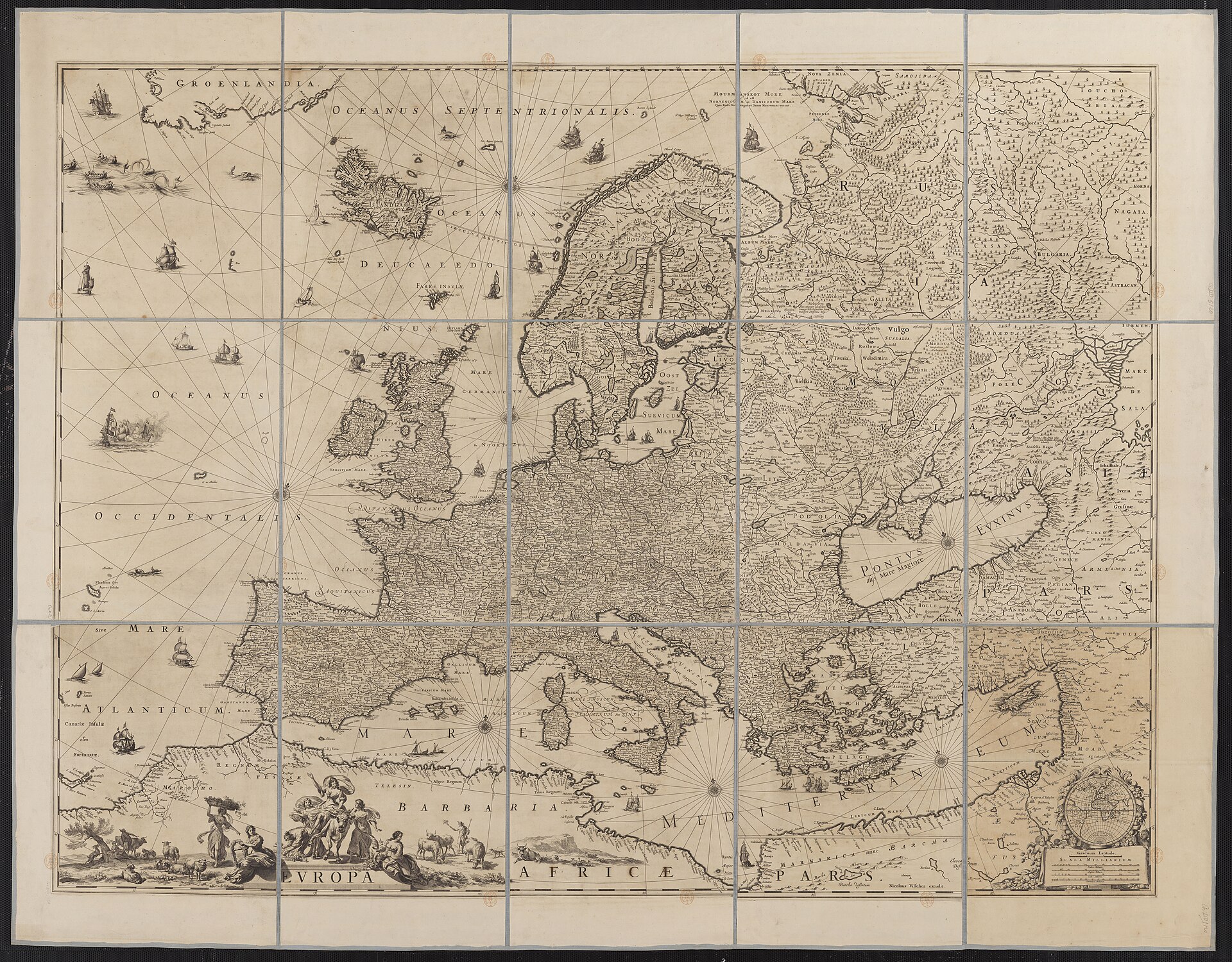
In 1649, with Ferdinand III’s permission, Froberger left Vienna for what we would today call a concert tour but which in 1649 had no name: a self-funded itinerant trip across the courts of Europe to give private recitals, exchange compositions, and sell manuscripts to subscribers. Over the next several years he visited Dresden (where he had a famous keyboard duel with Matthias Weckmann that both men agreed was a draw — they exchanged compositions afterwards and remained lifelong correspondents); Brussels (where the Archduke Leopold Wilhelm gave him an audience); Paris, where in 1652 he met and became close with the lutenist Charles de Blancrocher and the young Louis Couperin; and London, where the most extraordinary chapter of his life played out.
The story comes from the English ambassador to Vienna, Constantijn Huygens — who heard it from Froberger himself, and wrote it down in a letter of 1666. On the journey from Paris to London, Froberger was robbed by pirates in the Channel of his entire purse and all his manuscripts; he arrived in Dover with nothing but the clothes he stood up in. Begging passage upriver to London, he ended up on a small boat where, when the crew discovered he was a musician, they handed him a harpsichord. The story has him playing the instrument so beautifully on the deck of the boat that the king (Charles II had just returned to his court in 1660 — Huygens conflates the timeline somewhat) heard of it, summoned him to Whitehall, and paid him passage back to Vienna. The manuscripts were never recovered.
The Tombeau for Blancrocher
The friendship with Charles Fleury, Sieur de Blancrocher — the great Paris lutenist — was deeper. They spent the spring and summer of 1652 together in Paris, exchanging compositions, comparing instruments, copying manuscripts. In October Blancrocher fell down a staircase in his house and died of his injuries.
Froberger wrote the Tombeau in C minor within weeks. The piece is short — under four minutes — and is built throughout from the rhetorical figures of musical lament: descending chromatic bass lines, suspensions over the rests of falling intervals, broken arpeggiated chords. The closing bars depict the fall itself. A descending broken-chord figure spirals downward through three octaves, comes to rest on a single sustained C below the bass clef, and stops. The autograph has a marginal note: “icy l’on tombe sur la coulisse” — here one falls down the staircase. It is the first instance in keyboard literature of an actual physical event being depicted within an actual piece of music.
Yesterday at noon Blancrocher fell upon the stair, broke his neck, was carried up and lived but the rest of the day. Mr Froberger held him in his arms as he died.
— Constantijn Huygens, letter to a correspondent in The Hague, c. 1652 (paraphrased from the Dutch)
The same friend Huygens — the great Dutch poet, diplomat, and amateur musician — became one of Froberger’s most reliable patrons. The two corresponded for fifteen years. After Froberger’s death Huygens helped preserve the surviving manuscripts that we still play from.
Vienna, dismissal, Héricourt
The new Emperor Leopold I, who succeeded Ferdinand III in 1657, was not a music lover in his predecessor’s sense, and within months he dismissed Froberger from the Hofkapelle. The composer was forty-one and unemployed. He made his way west, eventually settling under the protection of Duchess Sibylla of Württemberg-Mömpelgard at her small Lutheran court in Héricourt, in the Franche-Comté. He spent his last ten years there as her keyboard teacher, household musician, and tenant.
He died at Héricourt on 6 May 1667, age fifty. The Duchess wrote about his last hours in a letter to Huygens:
He was about to sit at the table when, with no warning, he fell into his great chair and ceased to breathe. He could not have suffered ten minutes’ pain. … Such was the death of a man who had lived for so many years in expectation of his own.
— Duchess Sibylla of Württemberg-Mömpelgard to Constantijn Huygens, 23 May 1667
The expectation she refers to is one of Froberger’s strangest compositions: the Méditation faite sur ma mort future (FbWV 611), a slow F-minor allemande he composed years before his actual death, as a private rehearsal of what dying would feel like. The autograph carries the date and the signature J. J. Froberger. He performed it himself for friends.
The suite
Froberger’s structural contribution to keyboard music — independent of style, lasting beyond his immediate generation — was the standard suite of dances. Before him, dance pieces existed singly. After him, the order Allemande–Courante–Sarabande–Gigue was the unspoken rule. He arrived at this order gradually, across the suites he composed in Vienna in the 1640s and 1650s, and his autograph of the Libro Secondo (1649) is the first manuscript in which the order is consistent. Within a generation, every keyboard composer in northern Europe was following it. Bach’s English Suites, French Suites, and Partitas all preserve Froberger’s order intact — added an opening prelude and the occasional extra movement, but never broke the underlying ACSG.
The musicologist Howard Schott, editing Froberger in the 1970s, called him “the man who taught the keyboard how to be sad.” That is one half of his contribution. The other half is that he taught it where to put its feet — Allemande, Courante, Sarabande, Gigue, in that order, for the next two centuries.