A guide to
Jan Pieterszoon Sweelinck
Deventer 1562 — Amsterdam 1621
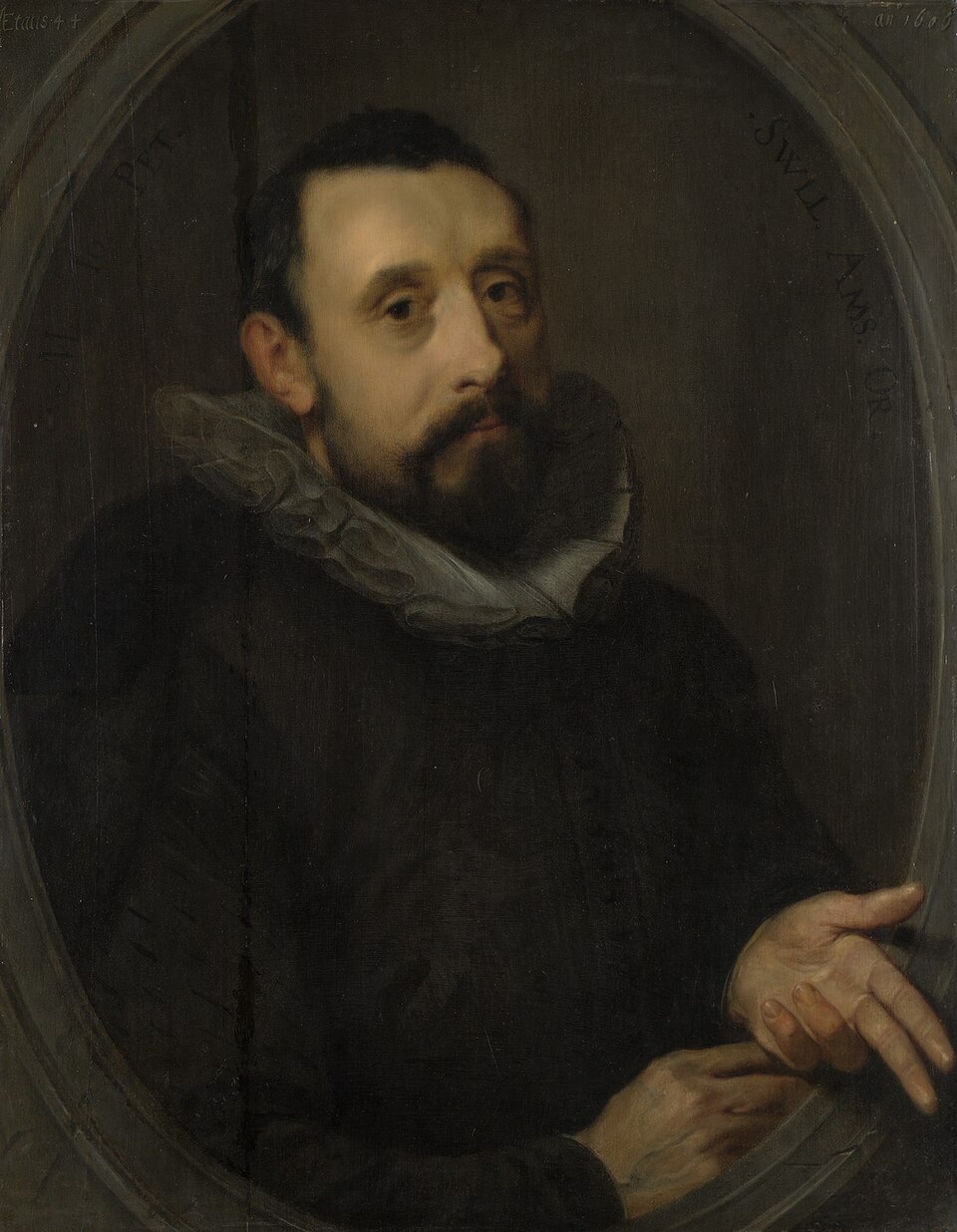
Jan Pieterszoon Sweelinck never left Amsterdam as an adult. He inherited his father’s organ-loft at the Oude Kerk (“Old Church”) around the age of fifteen, in 1577, and held the post for forty-four years until his death. He did not visit Rome, Paris, or London. He may, possibly, have travelled to Antwerp in his teens to study with Jacob Buus; the evidence is thin. Apart from one or two short trips inside the Dutch Republic to assess organs, his entire working life took place inside a square mile of one Dutch city. From that single fixed point he became, by way of his pupils, the founder of the North German organ school — and therefore the musical grandfather-figure of Buxtehude, Pachelbel, and, at three generations’ remove, of J. S. Bach.
The strangest organist post in Europe
The arrangement at the Oude Kerk was historically unique. The Reformation had reached the Northern Netherlands in the 1570s, and the Dutch Reformed Church — strictly Calvinist — had ruled that the organ was forbidden inside the Lutheran-style liturgy as a “popish indulgence.” So the Calvinist services at the Oude Kerk were silent of organ music; no chorale preludes before the psalm, no postludes after the blessing, no improvisation between the lessons.
The municipality of Amsterdam responded by separating the organist’s employment from the church’s. The city — not the consistory — paid Sweelinck’s salary, owned the organ, and used it for public recitals, not for worship. Twice every day, Sweelinck played a one-hour public organ recital in the Oude Kerk: the morning at 11 (after the morning sermon), the evening at 6 (before the evening service). The recitals were open to anyone; on summer afternoons the church filled with merchants, sailors from the harbour, and visiting musicians.
This is the institutional setting that produced his music. Sweelinck wrote not for liturgical use but for public musical instruction and entertainment — for the hour-long civic recital of a great trading city. His toccatas, fantasias, echo-fantasias, and variation sets are precisely the genres a daily public recital required.
The “Orpheus of Amsterdam” and his pupils
The lutenist Joachim van den Hove called him “Orpheus of Amsterdam” in 1612 — the nickname stuck — and by then Sweelinck’s annual class of organ pupils had become the most important pedagogical centre in north-western Europe. They came primarily from the German Hanseatic ports whose civic governments could afford to send a promising young organist to Amsterdam for two or three years of paid apprenticeship.
The roll call is the foundation of the North German organ school:
- Samuel Scheidt (Halle, 1607–09) — afterwards organist of the Moritzkirche Halle, whose Tabulatura Nova (1624) is the first printed German keyboard collection in modern open-score notation, and the foundational document of the North German school.
- Heinrich Scheidemann (Hamburg, 1611–14) — organist of the Catharinenkirche Hamburg from 1629 to 1663, predecessor in the city to Mattheson and grandfather-figure to Reincken.
- Jacob Praetorius (Hamburg, ~1606–08) — organist of the Petrikirche Hamburg until 1651.
- Paul Siefert (Danzig, 1607–10) — afterwards organist of the Marienkirche Danzig.
- Melchior Schildt (Hannover, 1609–12) — afterwards Hofkapellmeister at Copenhagen.
Each pupil returned home with Sweelinck’s fantasia and echo-fantasia idiom embedded in his hands, and built the next generation of North German organists on top of it. Buxtehude at Lübeck (1668–1707) was a pupil of Scheidemann’s pupil Lübeck; Pachelbel at Erfurt was a pupil of Buttstedt who was a pupil of Pachelbel-Senior who studied with… it is, by 1700, family trees branching out from a single Amsterdam classroom.
Hamburger Macht-Organisten haben alle bei meinem Vater gelernt — the mighty organists of Hamburg all learned from my father.
— Dirck Sweelinck (the composer’s son), letter to a correspondent in Cologne, c.1635
The music
Sweelinck’s keyboard output is preserved entirely in manuscript copies by his pupils — most importantly the Lynar Tablature (compiled by his pupil Andreas Düben around 1620) and the Buxheim-derived North German organ books. He published in his lifetime only vocal music — the great four-volume Pseaumes de David (1604–21), the Cantiones sacrae (1619), and the Rimes françoises et italiennes (1612) — leaving the keyboard works to the manuscript transmission of his students.
The keyboard output falls into four groups:
- Toccatas — short improvisatory pieces, often beginning with a sustained pedal point and elaborating it through scalewise passagework. The Italian root is obvious; Sweelinck almost certainly had a copy of Andrea Gabrieli’s printed toccatas.
- Fantasias — long contrapuntal pieces, sometimes built on a single theme worked through systematic stretti and inversions; the Fantasia chromatica is the masterpiece. These are the genre Bach would later inherit and transform into the great fugue.
- Echo fantasias — exploiting the two-manual organ’s dynamic split. The right-hand phrase is played forte on the Hauptwerk; immediately echoed piano on the Rückpositiv. The genre is essentially Sweelinck’s invention.
- Variation sets — on Dutch popular songs (Mein junges Leben hat ein End), on chorales, on dance tunes (Ballo del Granduca), and on English consort pieces (the Pavana lacrymae, after John Dowland). The variation procedure he develops here is the direct ancestor of Buxtehude’s chaconnes and Bach’s Passacaglia.
The end at the Oude Kerk
Sweelinck died at home in Amsterdam on 16 October 1621, age fifty-nine. He had outlived his wife by sixteen years. The cause of death is not recorded; his will, drawn up the previous summer, anticipated his end calmly.
He was buried inside the Oude Kerk — the church he had played in every day for forty-four years — under a flat marble slab now badly worn by foot-traffic. His son Dirck Janszoon Sweelinck succeeded him at the organ-loft and held the post until his own death in 1652. Through Dirck the manuscripts passed to other Amsterdam musicians, and from them — slowly, in copies and copies of copies — to Hamburg, to Halle, and ultimately to the Bach household.
What Sweelinck left was not a published Opera Omnia but a teaching tradition. Almost every important North German organist of the 17th century was either his pupil or his pupil’s pupil. From a single elevated organ loft in a single Dutch city he reshaped, by way of forty years of pupils and several thousand daily public recitals, the entire keyboard tradition of Protestant northern Europe.