A guide to
Georg Philipp Telemann
Magdeburg 1681 — Hamburg 1767
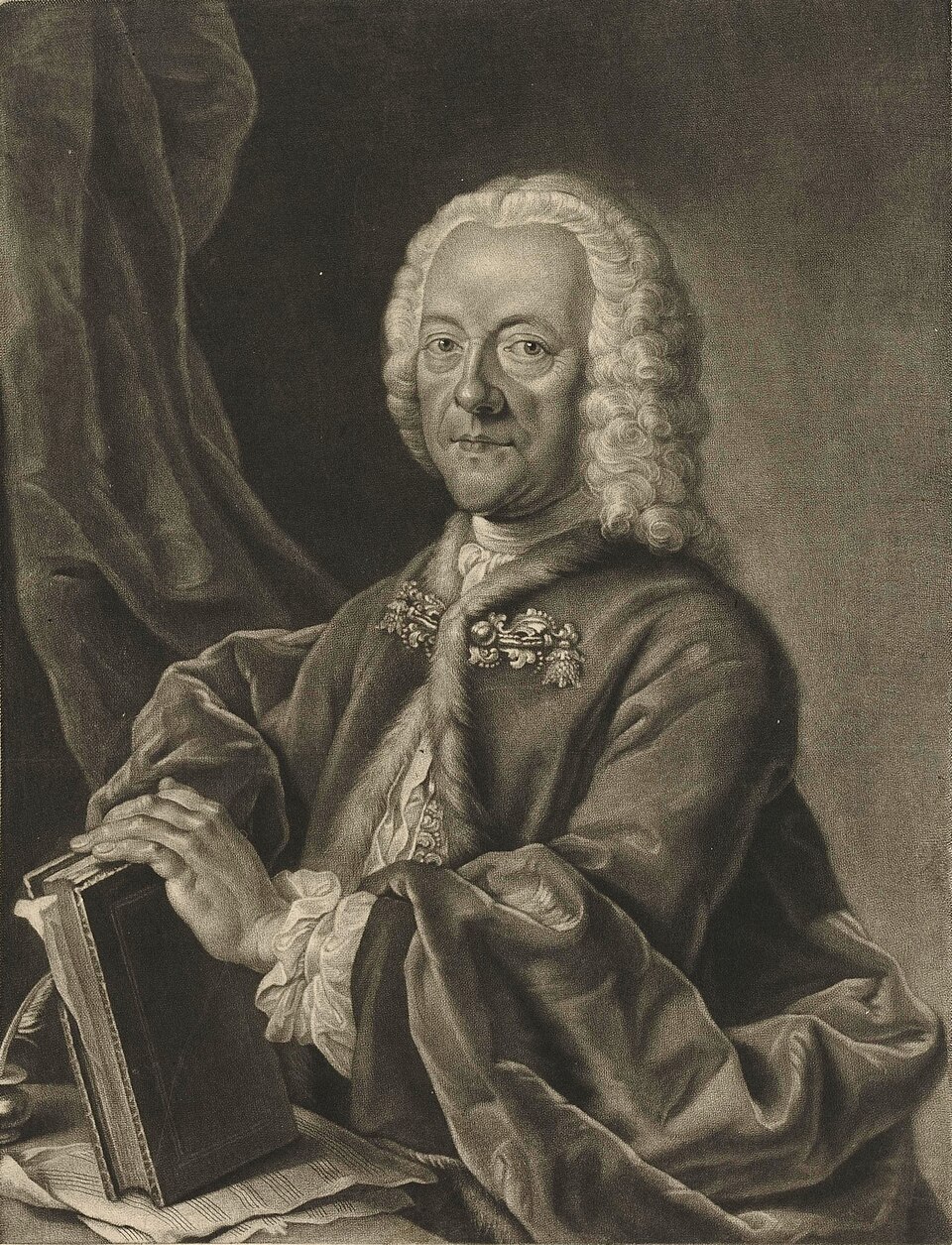
Georg Philipp Telemann was, by the unanimous judgment of his contemporaries, the most famous German composer of his age — more so than Bach, more so than Handel, more so by far than any of the older South German organists. When the Leipzig Thomaskantor post fell vacant in 1722 on the death of Johann Kuhnau, Telemann was the city’s first choice. He accepted in writing, then changed his mind and refused. The Leipzig council went next to Christoph Graupner (whose Darmstadt employer would not release him); only after Graupner’s refusal did the post pass to a third choice — Johann Sebastian Bach, whose contract specified explicitly that Bach was the council’s “tertia” selection. Telemann was the reason Bach got Leipzig.
Telemann was also the composer his contemporaries most consistently described as astonishingly easy to listen to. He wrote — by the most conservative modern count — over three thousand surviving compositions, including 1,750 cantatas, 46 Passions, hundreds of concertos, dozens of operas, and a flood of Hausmusik (household music) for the new middle-class amateurs whose market he largely invented. The total is so large that Telemann is the only composer in Western music whose catalogue exceeds the number of distinct days he lived. Bach wrote about a thousand works in sixty-five years. Telemann wrote three thousand in eighty-six.
A self-taught law student
He was born in Magdeburg on 14 March 1681, into a Lutheran clergyman’s family that forbade music as a career. Their son was supposed to be a pastor or a lawyer; his playing of every instrument in the household — by his own account, by age twelve he could play violin, recorder, zither, and four kinds of keyboard — was tolerated only as an entertainment. When his mother caught him composing an opera at age twelve, she confiscated his instruments and burnt the manuscripts.
He went on. By the time he was sent to Leipzig in 1701 to study law, he was already an accomplished composer in secret — and the very night he arrived in Leipzig, the dormitory roommate found the law student’s first composition lying on the bed, took it without permission to the Thomaskirche organist Johann Kuhnau, who liked it, and within months the Leipzig Burgomeister had commissioned Telemann to compose monthly cantatas for the Thomaskirche. The law degree was abandoned within a year.
In 1704 he founded the Collegium Musicum at Leipzig — a student musical society that gave weekly public concerts in Zimmermann’s coffee-house. The Collegium would, two decades later, become Bach’s vehicle for his great secular works (Bach took over the Collegium in 1729). Telemann founded it because there was no other way for a Leipzig audience to hear instrumental music outside the church liturgy. He invented the German concert-hall tradition twenty years before there was a hall.
Eisenach, Frankfurt, and the friendship with Bach
In 1708 Telemann moved to Eisenach as Kapellmeister to Duke Johann Wilhelm of Saxe-Eisenach. The post is musically minor — the orchestra was small — but the personal connection it produced is one of the central facts of Baroque music. Johann Sebastian Bach, then court organist at Weimar, lived a day’s ride away. The two became close friends.
Telemann was named godfather to Bach’s second son at the boy’s baptism in Weimar in March 1714. The boy was christened Carl Philipp Emanuel Bach in his honour. The two composers were Bach’s age and Telemann’s age respectively — Telemann was four years older — and remained correspondents for the rest of their lives. Letters between them survive; they exchanged compositions, traded subscribers for printed editions, and asked each other for advice on instrument purchases.
Although I never had the privilege of meeting Telemann face to face, I esteem him among the foremost of those whose music has moved me to compose; and the Musique de table of 1733 has been my constant companion at the keyboard for these last several years.
— George Frideric Handel, letter to Telemann’s brother-in-law, c.1740
(Handel subscribed to the Musique de table under the deliberate Italianisation “Signor Hendel, Maitre de Chapelle de S. M. Britannique.” The two never met.)
In 1712 Telemann moved to Frankfurt as city music director and Kapellmeister of the Barfüsserkirche. He spent nine productive years there before being head-hunted by Hamburg.
Hamburg: the great post
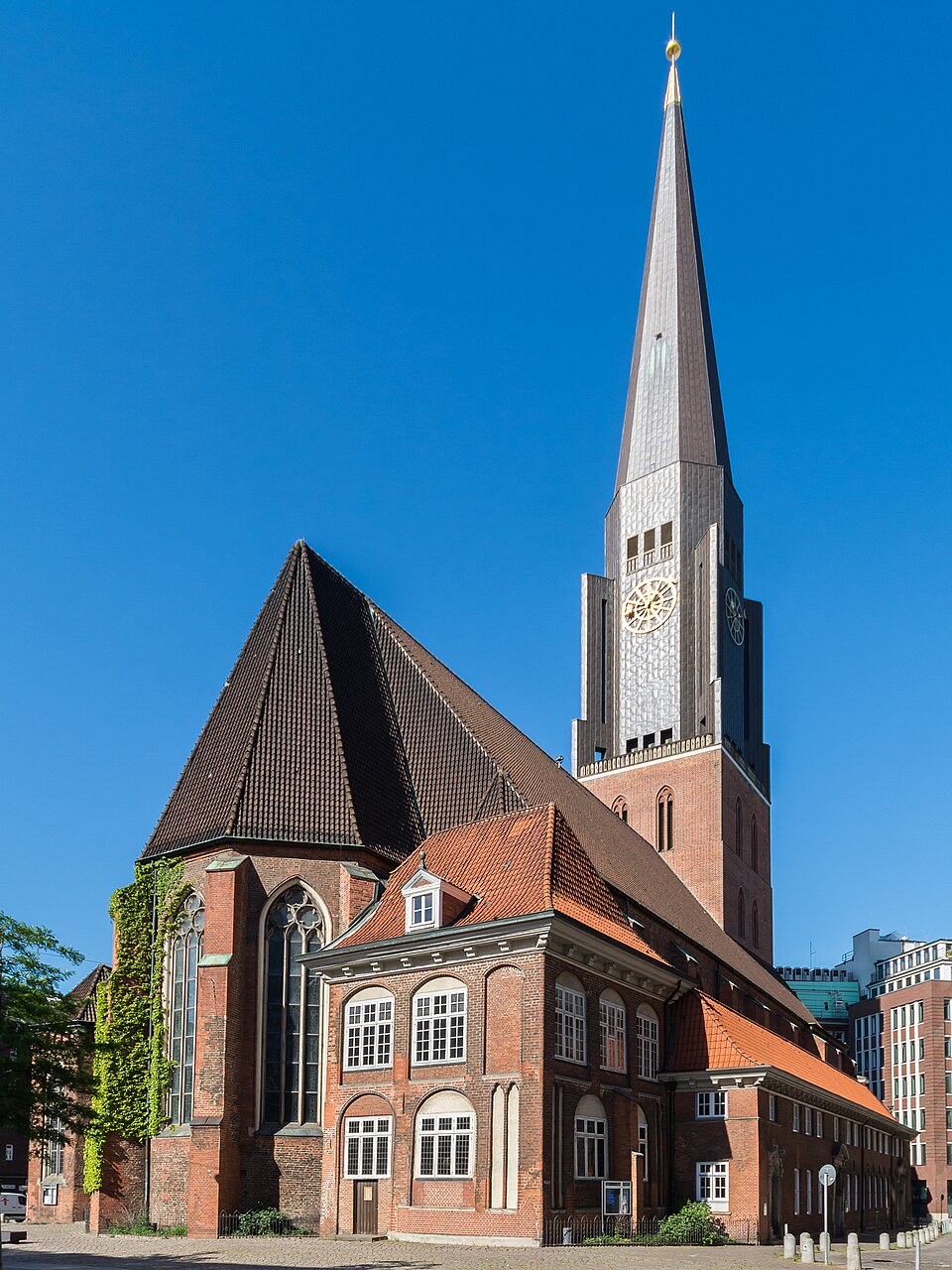
In 1721 Hamburg created for him a unique post: Director musices of the five great parish churches of the city (St Petri, St Nicolai, St Catharinen, St Jacobi, and St Michaelis), plus Cantor of the Johanneum Lateinschule. The salary was extraordinary by German Lutheran standards, and the responsibility — to compose two cantatas every Sunday for each of the five churches in rotation, plus Passions for Holy Week, plus festal music for civic occasions — was staggering. Telemann calmly produced it for forty-six years.
He also branched out. From 1722 to about 1738 he was simultaneously director of the Hamburg Opera at the Gänsemarkt, and from 1728 he ran an enormously successful music publishing house out of his own home in the Peterstraße — engraving and printing his own works and other composers’ on subscription. Hamburg was Germany’s commercial heart, and Telemann understood the commercial possibilities of music in a way nobody before him had. Bach in Leipzig never published more than a small fraction of his output; Telemann in Hamburg published almost everything he wrote.
The Hamburg years also produced the trip to Paris in 1737–38 — an eight-month visit by invitation of a circle of French musicians including the flautist Michel Blavet and the cellist Martin Berteau. Telemann played at Versailles, was paid by Louis XV, and brought back a French printing privilege that secured his publishing house through to his death. He was the only major German Baroque composer to travel to France, and he came home with the style français embedded in his fingers — visible immediately in the Paris Quartets (1738), his most exported chamber works.
The autobiography and the wife who ran off
Telemann published three autobiographies in his lifetime — 1718, 1729, and 1739 — each successive version expanded and updated. Together they are the liveliest first-person document we have from any Baroque composer. He describes his Magdeburg childhood with affection, his Leipzig years with gossip, his Eisenach days with warmth toward Bach, and his Hamburg success with unconcealed pride.
The autobiographies are notably silent about one episode. In 1736 his second wife, Maria Catharina Textor, ran away with a Swedish military officer — leaving Telemann with debts she had run up of roughly 3,000 thalers (he earned about 1,600 a year). Hamburg musical society organised a benefit concert and his composer friends abroad — Handel, Mattheson, Hasse — sent subscriptions to help him clear the debts. He was sixty-five and bewildered. The episode is recorded in council minutes and in private letters; Telemann himself never wrote about it.
He married no third time. He lived another thirty years.
The slow rediscovery
Telemann died in his Hamburg home on 25 June 1767, age eighty-six. His successor at the Director musices post was, by Telemann’s recommendation, his own godson — Carl Philipp Emanuel Bach. CPE held the post for the next twenty-one years.
The eighteenth century considered Telemann the greater composer than his friend Sebastian Bach. The nineteenth century reversed the judgment — by 1850 Telemann had been recategorised as a “merely fluent” hack, the workmanlike opposite of Bach’s profundity. Most of his three thousand works went unperformed for nearly two hundred years. The first modern Telemann edition began in 1953; it is, as of 2026, only about one-third complete.
What the rediscovery has revealed is a composer whose specific genius was the production, on demand, of music with the perfect amount of complexity for its audience and occasion. The cantatas are easier to sing than Bach’s and more rewarding than most contemporaries’; the chamber music is technically accessible enough for amateurs and ingenious enough for professionals; the keyboard fantasias have the inventiveness of Bach without the strenuousness. He was the most reliable composer in Europe for fifty years, and he was very nearly the most underrated for two centuries after.