A guide to
Robert Schumann
Zwickau 1810 — Endenich 1856
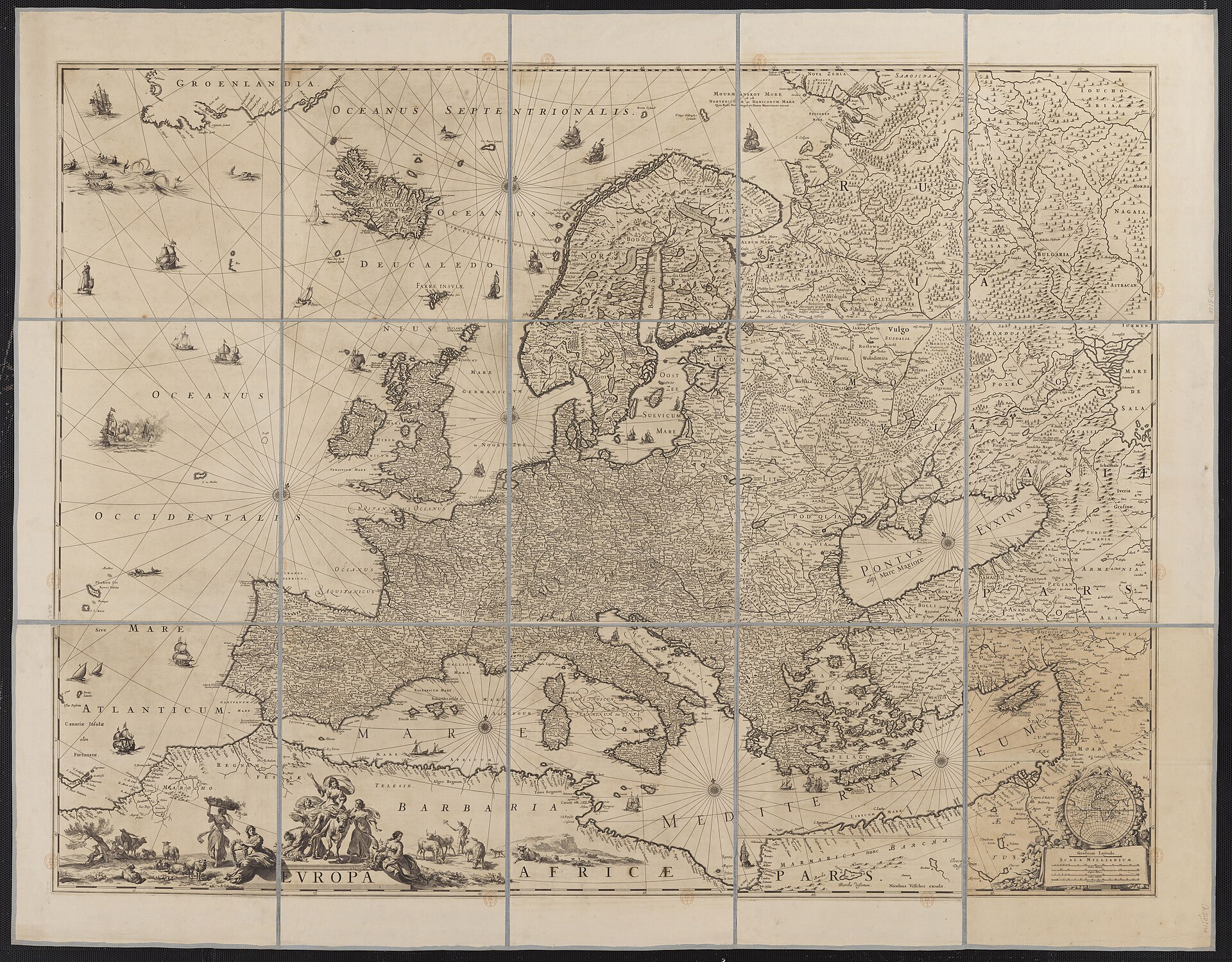
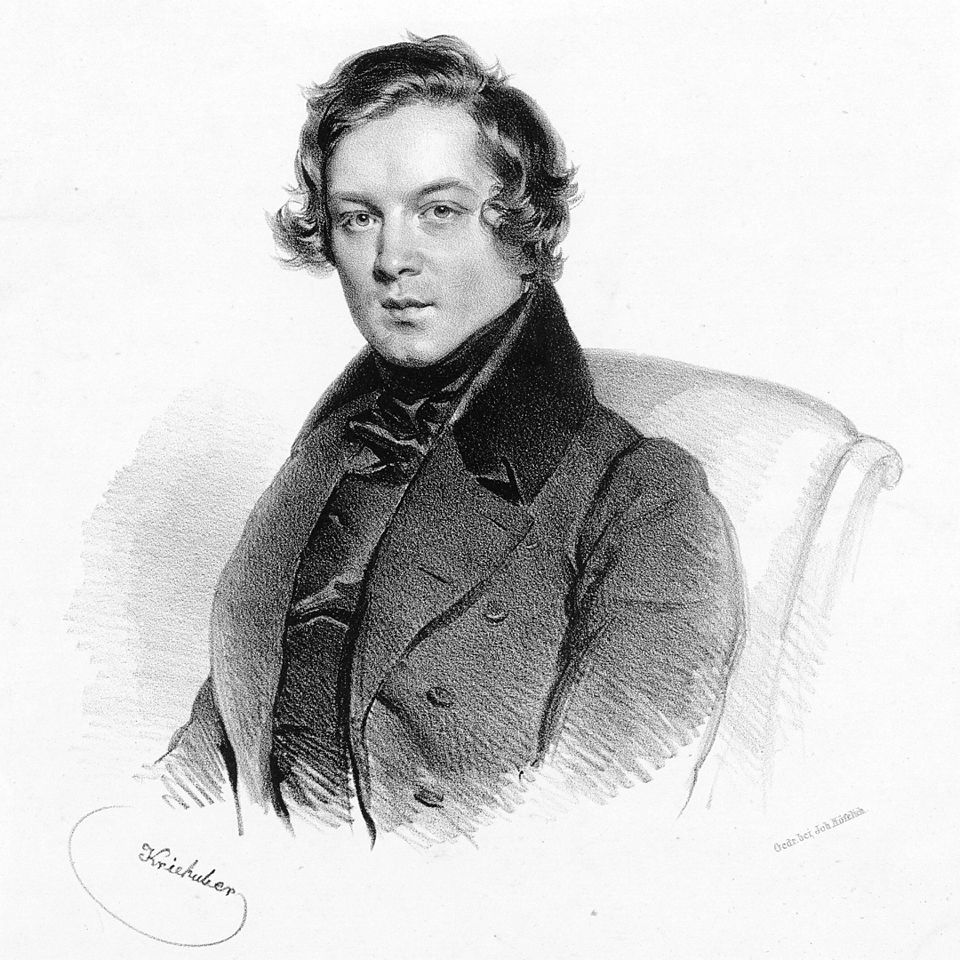
Robert Schumann was born in Zwickau, in the southern fringe of the Kingdom of Saxony, on 8 June 1810 — the same month as Chopin (one month younger), the same year as Liszt (Liszt three months younger), the same generation as the entire first wave of Romantic pianism. His father August Schumann was a bookseller and translator who supplied Robert with the entire English-language Romantic literature in the family library; the boy grew up reading Byron, Walter Scott, and (in German translation) Shakespeare alongside Schubert’s piano music. The literary saturation is one of the defining facts of his musical mind — the Davidsbündlertänze and Carnaval are sets of literary portraits before they are sets of dances.
In 1828 he was sent, against his wishes, to Leipzig to study law. The boarding arrangement put him in the household of one Friedrich Wieck, Leipzig’s leading piano teacher, whose nine-year-old daughter Clara Wieck was already a touring concert pianist of European reputation. Robert spent his “law” years almost entirely in Wieck’s music room, abandoning the law, taking piano lessons from Friedrich, and falling in love (in slow stages) with the daughter.
The career as a virtuoso pianist ended in 1830 when Schumann — twenty years old — devised a mechanical contraption to immobilise his fourth finger in order to strengthen the others. The device produced a chronic injury (the precise nature is still argued — some scholars now suspect tertiary syphilis or focal dystonia rather than mechanical damage) from which he never recovered. He could no longer play in public. He turned entirely to composition.
The marriage to Clara
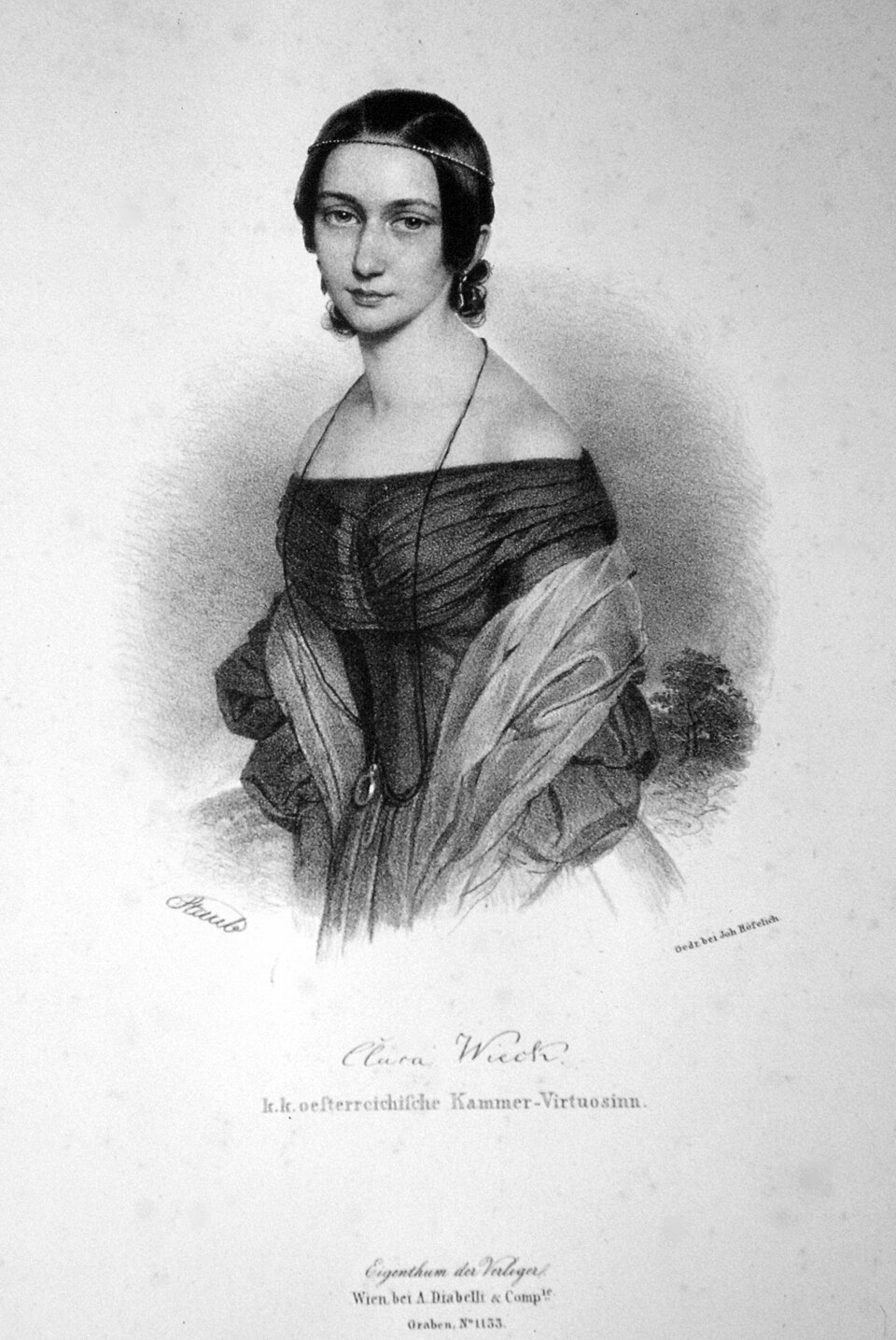
Schumann and Clara fell in love (according to Clara’s diary) when she was sixteen and he was twenty-five; they secretly engaged in 1837; Friedrich Wieck — Clara’s father, Robert’s former teacher — opposed the marriage with everything he had, fearing both the loss of his daughter’s career and (with some reason) Robert’s mental health. The legal battle dragged on for three years. Wieck attacked Schumann’s character, his finances, his drinking, and, in court, his sanity. The case ended in August 1840 when a Leipzig court ruled for the couple; they married on 12 September 1840, the day before Clara’s twenty-first birthday and her legal majority.
The marriage produced the great burst of song-composition known as the Liederjahr — Schumann wrote 138 songs in 1840 alone, including the entire Dichterliebe, the Frauenliebe und Leben, the Liederkreis Op. 39, the Heine songs Op. 24. Many of these were composed in single sittings in the weeks before and after the wedding. He wrote them in a state of euphoria he later described as “almost frightening to remember.”
Clara was the constant in his musical life. She premiered most of his major piano works, championed them in Europe for the rest of her long life (she outlived him by forty years), and edited the complete works after his death. She also composed her own piano concerto, sonata, and trio — works that have only entered the standard repertory in the last forty years. Her diary, kept jointly with Robert for the eight years after their marriage, is the most intimate marital-creative document in the entire Romantic repertoire.
The Neue Zeitschrift, Eusebius and Florestan
In 1834, six years before the marriage, Schumann had founded the Neue Zeitschrift für Musik (“New Journal for Music”) — a Leipzig periodical of musical criticism that he edited single-handedly for ten years. He wrote under multiple pseudonyms for his own journal, principally:
- Florestan — the impulsive, extroverted, brilliantly aggressive critic
- Eusebius — the dreaming, melancholy, contemplative critic
- Master Raro — the mature reconciling figure who synthesised the two
Schumann wrote dialogues between his pseudonyms in his own journal. He used the names again as character titles in Carnaval (Op. 9, 1834–35), Davidsbündlertänze (Op. 6, 1837), and the Kreisleriana (Op. 16, 1838) — Eusebius and Florestan are characters in those piano cycles, with their distinct musical voices, alternating sections in conversation.
The journal also discovered composers. The most famous single article Schumann ever wrote was the 1853 essay “Neue Bahnen” (“New Paths”) — his last piece for the Zeitschrift before commitment — in which he introduced to the European musical public a twenty-year-old unknown composer he had heard play in Hamburg two months before:
A young man has emerged, over whose cradle Graces and Heroes have stood watch. His name is Johannes Brahms.
— Robert Schumann, “Neue Bahnen,” Neue Zeitschrift für Musik, 28 October 1853
Brahms was twenty. The article launched his career.
Düsseldorf, the breakdown, and Endenich
In 1850 Schumann accepted the post of Music Director of Düsseldorf — his only paid municipal-music post — and moved with Clara and their seven children to the Rhineland. The post went badly. Schumann was, by 1853, an inadequate conductor: vague beats, distracted rehearsals, an inability to communicate with orchestral musicians. The Düsseldorf orchestra petitioned the city to remove him; the city offered him a quiet retirement; Schumann took it as a personal insult and resigned in protest.
The auditory hallucinations had begun earlier. By early 1854 Schumann was hearing a continuous A pitched note — what we would now diagnose as severe tinnitus — and around it a “chorale of angels” that, by night, became “demonic voices.” On 27 February 1854 he left his Düsseldorf apartment in his dressing-gown and slippers, walked to the Rhine bridge, and threw himself into the river. Fishermen pulled him out. He was lucid enough on the bank to ask, in his physician’s account, to be committed to an asylum so that Clara would no longer suffer.
The asylum was Dr Franz Richarz’s private institution at Endenich, near Bonn. Schumann lived there for two years and five months, lucid in occasional intervals but increasingly silent. Clara was not allowed to visit until two days before his death — Richarz feared the emotional toll would be too much for either of them. The composer Johannes Brahms, who had been twenty when Schumann discovered him, was the family friend who shuttled between Endenich and Clara’s home through those years, carrying news in both directions.
Schumann died at Endenich on 29 July 1856, age forty-six. The cause of death was officially “self-starvation”; modern diagnosis suggests a combination of tertiary syphilis, severe depression, and the general paresis of the late syphilitic. The post-mortem record was lost when Endenich’s archives were partially destroyed in the Second World War.
He was buried at the Alter Friedhof, Bonn, in a grave Brahms had organised. Clara survived him by forty years; she is buried beside him.
The marriage diary — the one Robert and Clara had kept jointly through their first eight years — Clara published in part. The asylum letters — what Robert wrote from Endenich to Clara, and what she wrote in reply — survived in the family until 1973, when they were finally released to scholarship. They contain the most heartbreaking private music in the entire Romantic correspondence.